Showing posts with label FOI. Show all posts

Tuesday, 22 March 2022

The only TWO options are the SIX options they really considered!

 When are two options not really two options? Well when Derby City Council and Derbyshire County Council are involved it is usually when the councils are claiming to the public there are only two options to be considered for the controversial Sinfin incinerator - the Derby and Derbyshire Waste Treatment Centre on Sinfin Lane in Derby. 

The councils claimed as follows in November 2021.

"Cabinet members at Derby City Council and Derbyshire County Council will be asked to approve a recommendation to develop a business case for the future of the waste treatment facility in Sinfin at their respective Council Cabinet meetings later today.

The business case compares two options:

•            To rectify and use the facility and,

•            To close the facility and dispose of the councils’ waste using a third party.

The business case will be developed over the next few months. Once complete, both councils will reconvene to review and decide how to proceed."

So it was fix it and use it, or dump it. No more than that, no suggestion that there was a raft of alternative options! options that could be considered as an alternative for the site in Sinfin Lane. The reality however was rather different to the picture the councils painted to the public back in November 2021 when they were considering the future of the site. 

Now us mere resident nobodies were excluded from the meetings of the council cabinets and had at the time no access to the cabinet documents or in the case of Derby City also access to the documents provided to the councils Executive Scrutiny Board which met the day before the cabinet meetings in question. Obviously they had nothing to hide being so open and transparent as this - it is perfectly normal to hide all the documents on the subject from residents because come on there are two options being considered, the councils said so and so that must be true right?

WRONG!

 THERE WERE SIX OPTIONS THAT WERE BEING CONSIDERED !

Clearly in the interests of being open and transparent the councils decided to only tell the public they were considering TWO options. Maybe the councils thought that the public could not handle all this information that they would face so wanted to protect the public from this - or maybe they just set out to mislead the public into thinking there were only two options being considered!

As a resident of Derby and also a member of the Sinfin plants Community Liaison Group (CLG) personally I consider that the councils set out to mislead the public when issuing their statements because the councils clearly want to pitch repairing and using the plant - which just so happens to tick all of the boxes in the strategic aims against complete closure which ticked almost none of the boxes. We all know that it is very easy to formulate a set of tests to gain the result you want which in my view is why it was important for the councils to keep the other options hidden from the public because some of them could be considered to be better options in the public eye than the councils want - and obviously that would never do!

A Freedom of Information / Environmental Information request was submitted in November 2021 for the documents from the meeting to Derby City Council. The council managed to fob off my request for far longer than is usually considered acceptable by blaming issues around work levels at the council department in question. Finally they had to issue the documents to me - although in a redacted state there was enough left un redacted for readers to identify that unlike the claimed two options considered there were actually SIX options being considered. Ranging from full repair to closure but also including use of specific sections of the plant to produce refuse derived fuel or to act as a waste transfer site and also even an option considering leasing or selling the site off to a third party.

So what could possibly be the reason for the councils only telling the public there were two options being considered? Surely from past experience they would know that some members of the public would cast their eye over the situation and even make a Freedom Of Information request - FOI or its Environmental brother the EIR. It is not clear why someone somewhere decided to make a public statement that they were to consider two options because surely it would be better to admit to six options while saying two would be considered further. By doing so they would be open and transparent and this would encourage public trust.

So obviously I had to make a request to Derby City Council for the documents from the November 2021 Scrutiny Board meeting and Council Cabinet meetings which took place in an attempt to help the councils to be open and transparent because clearly it is something they struggle with! So that is where it became clear scattered between the heavily redacted texts that there was a broader series of options.

Option ONE was to fix and use the full plant - but on that option the councils redacted all the text relating to RISK 

Being open and transparent the councils clearly have nothing to hide by errr hiding all the risks being considered!
We know that even if "fixed" the inefficient plant which is considered a disposal plant at the bottom of the waste hierarchy will be even worse from an efficiency perspective because the document tells us this!

Also strangely no acknowledgement of fly related issues in the community which vanished when the plant was closed and cleaned.

Option TWO was a secret option ssshhhh dont tell the public! the proposal in this case was to use the front end of the plant which was the Materials Recovery Facility (MRF) and the Mechanical Biological Treatment section (MBT) to create a refuse derived fuel (RDF) to be burnt off site. No acknowledgement of fly related issues on the community which vanished when the plant was closed and cleaned. No reference to odour related objections. 

Option THREE was another secret option ssshhhh dont tell the public! the proposal in this case was to only use the MRF as a "dirty" MRF to extract some recyclables from the waste before shredding the waste and sending it out as an RDF fuel to be burnt off site. No acknowledgement of fly related issues in the community which vanished when the plant was closed and cleaned. Strangely refers to odour issues - which it strangely did not refer to in option two.

Option FOUR was another secret option ssshhhh dont tell the public! the proposal in this case was to use the site as a waste transfer station where the waste would be bulked up and not treated on site before being sent for disposal elsewhere. No acknowledgement of fly related issues in the community which vanished when the plant was closed and cleaned.

Option FIVE is the option of closure of the plant - the residents all time favourite option but sadly it appears not the councils favourite option but one which is a useful tool for pushing through the councils favoured option of fixing and using the plant. This option which almost without fail successfully gives the answer NO to the councils selected strategic aims plays a key part in the councils consideration as it is the only other option they told the public about!

Option SIX was the final ssshhhh secret option dont tell the public! the proposal in this case was to sell or lease the plant to the private market. The document indicates that soft marketing along those lines did not turn up any interested parties in the purchase or lease of the plant.


 Maybe the fact that nobody is interested should be taken on board by the councils when considering if they themselves should attempt to fix and use the plant!

The councils in their documents go on to point score options 1-5 in relation to strategic fit. They do not consider option 6 (sale or lease) as they conclude it is not a likely option - considering no parties came forward via soft marketing.
The point scoring was as follows


We can see from the strategic fit criteria that as expected repair and use is ranked 1st compared to closure as ranked joint 4th.
It is not possible to judge the councils approach to the options financial fit because that section of the documents has a sponsorship deal with a redaction pen company and so it is not possible currently to understand the costs involved in relation to the SIX sorry TWO options the councils told the public they were considering. 
The councils are going through the motions attempting to convince the public they are considering long term closure of the site while running up ever higher multi million pound maintenance bills and considering the out of date plant at the bottom of the waste hierarchy against a joint waste strategy that will be out of date in 2026.
Surely they would not invest heavily in old technology that has been shown to be even less efficient than planned and unable to meet the requirements of the current joint waste contract never mind the expected efficiency you would expect of a future waste strategy that works to head towards net zero! 

©SIMON BACON 2022


Monday, 7 May 2018

Get ya ROCs off!

On April 30th 2018 Resource Recovery Solutions Derbyshire Ltd (RRS) announced that their controversial waste gasification incineration plant had been granted ROCs - Renewable Obligation Certificates for the electrical energy they will produce from the biodegradable aspect of household waste which the plant will take in for burning.
Renewi one of the parent companies of RRS released a press release relating to the granting of ROCs to the Sinfin Lane, Derby project which contain quite a degree of hot air.
They stated that "Up to 98% of the residual waste managed at the facility will be diverted from landfill, which will also generate enough green electricity to power approximately 14,000 homes."
While the plant may generate enough electricity for 14,000 homes - that is yet to be shown one thing is for sure - an unconfirmed percentage of the power generated will come not from so called green electricity - which is considered by the likes of OFGEM as biodegradable wastes being combusted but in fact non biodegradable waste such as plastics - ie fossil fuels.
It is fact (confirmed via FOI/EIR) that in the city of Derby 9,000 properties have no recycling scheme in place - after Derby City Council removed the service stating recycling bin contamination as an excuse.
What this means is that a percentage of waste entering the Sinfin facility will have had no prior recycling applied to it. Paper and card should have been recycled removing it from the residual waste stream entering the Sinfin site in Derby. Instead such material is condemned to be burnt to generate OFGEM funded electricity via ROC payments - ROCs being funded from green charges applied to our energy bills.
Has recycling been removed in the city to procure suitable waste to generate lucrative ROC payments?

Someone called James Priestley said the following-


James Priestley, Managing Director of Renewi’s Municipal Division, said:


 “We are delighted to have been awarded this important ROCs accreditation which is another significant milestone achieved in this project. Not only does this accreditation bring financial support to the project, it also shows how we are using innovative technologies to operate sustainably, divert waste from landfill and create valuable products from waste. We are looking forward to completing the final stages of commissioning and to providing first class, sustainable waste services for the people of Derby and Derbyshire.”
  Now when you use the terms innovative and first class you think ground breaking and efficient and you could be forgiven for thinking this applied in the Derby projects case but the reality is somewhat different.
At the second public inquiry into the project the planning inspector required RRS to provide evidence of their projects energy efficiency status - an important aspect of the project which was a useful insight into the project.

At the second public inquiry RRS were forced to admit that
 in the plants standard electricity only mode their plant was in fact nothing more than what is known as a D10 disposal plant because the energy efficiency status of the process falls below that which would class the plant as an efficient recovery process.

 
To see what the Waste Framework Directive says about a plant being recovery R1 or disposal D10 below is a series of quotes from the directive.

Recovery or disposal – the meaning of R1

47. The Waste Framework Directive (WFD) sets out the waste hierarchy and enshrines it in law. It requires that a waste management route defined as recovery should be used ahead of an alternative that is classified as disposal. Exceptions can be made (see below) but this general principle makes it important to know whether a process is considered recovery or disposal. 

48. Historically the Waste Framework Directives have included annexes which set out lists of what are considered to be recovery or disposal operations. Each is given a number and a letter: R for recovery, D for disposal. In the current directive the classifications of particular relevance to energy from waste are: • R1 – Use principally as a fuel or other means to generate energy • D10 – Incineration on land 

49. What this means is that where waste is burnt as a fuel to generate energy it can potentially be considered a recovery operation (R1) but where the purpose of incineration is to get rid of waste, it is considered D10 and hence disposal.  All municipal waste incinerators were and are deemed as disposal activities (D10) unless and until they are shown to meet the requirements of R1. This is why the term R1 often crops up in the debate about how good an energy from waste plant might be and how it compares to other options. 

50. For municipal solid waste, which includes all the waste collected from households, the EU has gone further by defining what it considers to be sufficient for recovery status under R1. The WFD includes a formula relating to the efficiency of the combustion plant. A municipal waste combustion plant can only be considered to be a recovery operation under R1 if it generates energy and the plant meets the efficiency thresholds calculated using the R1 formula

SO THAT IS THE OFFICIAL BLURB FROM DEFRA ON RECOVERY OR DISPOSAL PLANTS AS GOVERNED BY EU DIRECTIVES - WHICH STILL GOVERN THE UK SINCE BREXIT.

Why are OFGEM supporting inefficient waste gasification incineration plants? the lure of lucrative subsidies in this case in Sinfin Derby has in part led to the route this project has taken which is condemning resources to being burnt for a small amount of energy made financially viable by government subsidy.

OFGEM are rewarding failure.

©SIMON BACON 2018

Monday, 27 November 2017

Recycling! now is the time to give it back!

My previous blog post placed focus on the two faces of recycling in Derby UK.
On the one hand as Zero Waste Week was taking place the council was using social media to project an image of its recycling success while at the same time hundreds if not thousands of Derby residents in areas such as Normanton and Arboretum ward had had their kerbside recycling service removed a few years back. EIR / FOI data shows there are actually around 9,000 properties without a blue bin recycling service in the city. 
You can read more about the two faces of Derby recycling here-
 http://derby-waste-a-rubbish-blog.blogspot.co.uk/2017/09/the-two-faces-of-recycling-in-derby-uk.html

The importance of recycling cannot be ignored - both from a sustainability aspect and a financial aspect as it is so much cheaper to recycle than to send waste to landfill or incineration.
The removal of recycling in the city was carried out for some questionable reasons in recent years and one thought is that this was an attempt to procure a feedstock for the controversial Sinfin waste gasification incineration plant in the city which is due to start operation soon.
They failed to address recycling contamination issues in those areas, left recycling bins festering for weeks if not months and then claimed contamination was a serious issue.
Contamination IS a serious issue if you do not address the issue!
The councils answer was to remove the service - quite convenient when you need to procure waste to burn!
What happened was they convinced other Derby residents that residents in the areas in question either didn't care or were to stupid to understand how to recycle!
The council was then able to sweep away the blue bin recycling service in many streets even though it was shown via FOI that they had no evidence to justify the service removal when the council targeted my own street - thankfully in my case they did not remove the service.
Replacement bring sites were put in place finally to provide some form of service for those who wanted to recycle.
What they actually did was install prime fly tip hot spots such as this one at Grove Street carpark in the Arboretum ward.


One of the saddest sights I have seen at a recycling site in recent times was a bag of plastic recyclables left at the bring site above which will have had no chance of being recycled because the bins were full and fly tipping surrounded the site.
The fact someone went to this trouble shows people care! The note on the bag says PLASTIC.

 
With the bring sites becoming quite a state 2-3 of the sites were removed by the council - once again condemning residents to having no recycling service.
This prompted me to put a question to the council cabinet member for waste Cllr Asaf Afzal at a recent Full Council meeting in the city regarding bring site provision. 
 
Question from Simon Bacon to Councillor Afzal
The city council removed the bring recycling site on Havelock Road in Normanton due to fly tip issues. This means that local residents have no ability to recycle their rubbish. When will the city council be replacing this bring site with an alternative site in that area of the community?
 
As you have mentioned these sites have attracted fly tipping. The council do not intend to replace any of the bring sites with alternative sites due to the costs and resources needed to maintain them.

From this we can see that the council does not care that their residents have had their ability to recycle removed as it is a case of - no its gone and your not getting it back!

But in recent months the council has done something positive which is to finally listen to local people who pushed for fly tip and wheeled bin enforcement in the city.
Enforcement of the wheeled bins - where residents are issued section 46 notices advising them that they can only have their waste bins in the streets at specific times.
In my view one of the biggest issues with bins on streets is the fact that this led to recycling bins being contaminated - as people passing in the street used them as normal bins for litter or fly tippers made use of the fact they could place whole bags of mixed waste in the bins.
 
So considering that the council now had staff in place to improve the street scene by targeting bins on streets but also importantly that these same staff were engaging with residents what better time could there be to use the enforcement staff to provide information on recycling at the same time they engaged with residents about their bins - an all in one process which would both address bins on streets and recycling contamination issues.
 once carried out in an area it would seem sensible to put back in place the blue bin recycling scheme due to the reduced risk of bin contamination and the fact that recycling is so much cheaper
.
So the question had to be posed!

Question from Simon Bacon to Councillor Afzal

With the successful work being carried out by the councils new Community Protection Officers to remove bins off streets in areas such as Normanton, will the council now return the blue bin recycling service to the streets targeted by the CPOs due to the reduced risk of bin contamination?

The contamination levels of the blue bins were very high. It is the council's intention not to return the blue bin recycling scheme to these areas as it proved expensive to operate and administer.
 
 
What we have is a council that for some reason does not want to recycle! its recycling rate has collapsed in recent years and surely the return of a service taking us back in the right direction - A CHEAPER SERVICE should be the way forward.


©SIMON BACON 2017

Sunday, 25 June 2017

Hidden contracts! the public strikes back!

On 22nd October 2015 I Simon Bacon the writer of this blog applied to Derby City Council in Derby UK via FOI / EIR requesting the following information relating to the controversial joint waste contract linked to the highly controversial Sinfin, Derby gasification incineration plant.
 1- ALL CONTRACTS BETWEEN DERBY CITY COUNCIL AND DERBYSHIRE COUNTY COUNCIL RELATING TO THE JOINT WASTE CONTRACT.
 2- ALL CONTRACTS BETWEEN DERBY CITY COUNCIL AND ITS PARTNER DERBYSHIRE COUNTY COUNCIL WITH RESOURCE RECOVERY SOLUTIONS (RRS) AND / OR ITS PARENT COMPANY SHANKS / INTERSERVE.
 3- ALL CONTRACTS RELATING TO THE USE OF THE SINFIN TANNERY SITE - OWNED BY DERBY CITY COUNCIL BY RESOURCE RECOVERY SOLUTIONS (RRS) OR OTHER PARTIES.
 Derby City Council responded on 17th December 2015 in which it disclosed some of the requested information but withheld some of the information in part 2 of the request claiming the adverse affect to the confidentiality of commercial information. What was provided was a series of documents with many redacted (blacked out pages) where the council and its supporters - Derbyshire County Council and Resource Recovery Solutions edited the documents to hide certain aspects of the documents which they did not want the public to see.
Here are a couple of examples from schedule 14 of the contract which covers the performance mechanism.


As you can see from the images when they redact information they really black it out!
 
I appealed this ruling and Derby City Council carried out an internal review and responded to me on December 24th 2015 that it maintained this position.

Having considered this battle of wills further I made a complaint against Derby City Council on 22nd February 2016 to the ICO - the Information Commissioner. The ICO then gave full consideration to my strongly put appeal while engaging with Derby City Council further.
The council and its fellow contract members attempted to paint a picture which included impacts on interests of Resource Recovery Solutions (RRS) siting that the withheld information included price mechanisms, volume allocations and proprietary contract tools and processes.
The council argued that RRS operated in a competitive waste market and disclosure would allow competitors to work out the deal and how it was structured resulting in a loss of its competitive edge.
The council went on to argue that the Sinfin waste sites novel nature has the capacity to become a "BEACON OF EXCELLENCE"
 
ENERGOS the developer of the incineration equipment being installed into this beacon of excellence had gone into administration in mid July 2016.
 
It was suggested that the competitors of RRS would benefit from the unique know how contained within the information and thus undermine the ability of RRS to utilise this for its own benefit damaging its commercial interests.
Other than the Derby, Glasgow and Milton Keynes projects that have moved ahead there is little evidence of other projects moving forward using such technology and in recent weeks a proposal to install similar tech on the Isle of Wight has been dropped - so not quite the beacon being suggested.

The ICO asked the council to provide a new schedule setting out in each instance the councils rationale for withholding information so that it matched the specific parts of the documents. Having been given further time to do so the council advised it had approached RRS and Derbyshire County Council but that they had declined to provide any further arguments or clarification.
The ICO in their ruling considered that the lack of clarity in the councils submissions suggests that the council either does not properly understand what the effects of disclosure would be or has struggled to meet the evidential and explanatory burden set by the exception.
 
 On 4th August 2016 the Information commissioner at the ICO RULED IN MY FAVOUR instructing Derby City Council to disclose the withheld information to myself as the complainant.
 
In early September 2016 Derby City Council was in no mood to lose their battle again a resident of Derby so instructed its legal team to appeal the ICO ruling and so work started on a legal appeal.

I as the original applicant was also in no mood to lose the battle and so registered as a party to the appeal which WAS set to be heard later in 2017 in London UK. After a delay of a number of months as two similar cases passed through the tribunal system the Derby case began to move forward.

In recent months a similar case relating to an incineration plant in Gloucestershire and its associated contract pretty much ruled in the original applicants favour - while the council in that case attempted to put a brave face on things while putting some spin on the ruling the applicants in Gloucestershire are very happy with the result of their battle. A similar ruling regarding an incineration plant contract in Worcestershire also placed pressure on Derby City Council who were then set a date by the General Regulatory Chamber who were running the appeal by Derby City Council where the council had to acknowledge if it proposed to continue with their appeal.
So two other appeals went against the local councils which forced Derby City Council into a corner over their appeal against the ICO ruling.
 Did they continue or did they rollover!
 
THEY ROLLED OVER AND BAILED OUT OF THEIR APPEAL ON MAY 11TH 2017

The councils legal team made the following statements when terminating the councils appeal.
"
"Our clients have been carrying out a fresh, detailed, careful and considered review of the disputed information with all interested parties taking into account the passage of time and developments since the initial request and the commencement of the Appeal.
Having concluded that reassessment and made recommendations accordingly, the interested parties have respectively reached agreed conclusions and advised the relevant public authority which has been able to make an updated decision on disclosure as a result.
Our clients have invested a great deal of time in reaching this decision and it is not one that has been taken lightly. Despite considering that much of the disputed information remains commercially sensitive and confidential, given the time that has now passed since the original request for information by the applicant and taking into consideration the current stage the facilities are now at, the likelihood of probable harm from disclosure of the disputed information into the public domain has reduced.
As a result our clients have asked us to confirm that the disputed information will be disclosed in its entirety. "
 
 Derby City Council admitted at a recent full council meeting that they and their supporters - Derbyshire County Council and RRS / SHANKS had already spent £20,000 on their fight to keep aspects of the Derby and Derbyshire waste contract secret - hidden away from the public. In a strange twist they appeared to be suggesting to the local newspaper the Derby Telegraph that they had NOT paid £20,000 to stop me from gaining a copy of the contracts as reported here http://www.derbytelegraph.co.uk/derby-man-wins-right-to-see-controversial-sinfin-incinerator-contract-but-council-to-appeal/story-30288364-detail/story.html
 
The council was simply playing with words - £20,000 was spent but the city council only paid a third of the payment!

What are they trying to hide from the residents of Derby and Derbyshire ? what is so controversial that they redact whole pages of their waste contract ?  In these times of austerity and government cuts surely the public have a right to know what their taxes are being spent on.

NOW WE HAVE THE CHANCE TO FIND OUT!

©SIMON BACON 2017


Sunday, 26 February 2017

Something is rotten in the brown bin!

THE £40 BROWN BIN CHARGE 
 A LOOK BACK AT THE DECISION TO BRING IN A CHARGE FOR GARDEN WASTE IN DERBY UK.
 FIRST WRITTEN AT THE TIME THE PROPOSAL WAS PUT IN PLACE BUT NOW INCLUDES UPDATES.
         Derby told DEFRA they had in use 89,215 brown bins in 2012/13.
It isn’t clear if that includes homes who had a 2nd brown bin.
Council accountants confirmed to me that in 2012/13 19975.11 tonnes of waste was handled via the brown bin at a cost of £49.13 per tonne – As confirmed by Russell Sexton at Derby City Council.
This is a cost of £981,451.63 plus a collection cost of a claimed £880,000 as confirmed by Malcolm Price at Derby City Council via email giving a total of £1,861,451.63
If these figures are correct that produces a cost per household in the last financial year to the council of £20.86 for a full year including food waste which clearly isn’t £40 without food waste for a part year.
If we presume there are 100,000 bins as is often considered to be the case that becomes £18.61
That waste in general has to be collected whatever bin lorry collects it – once in the RRS / SHANKS residual waste contract that waste would cost at least £100 per tonne to handle – ie circa £1,997,500 WITHOUT THE COLLECTION COST.
 2015/16 costs were at least £107.40 per tonne and at a recent Full Council meeting it was quoted as £120.00 in 2016/17.
 An FOI request was made for all documents relating to the brown bin £40 charge proposal.
Documents show the council expected a 10% fall in recycling – based on the 2012/13 recycling rate of 45% will mean a plunge from 48% in 2010/11 to 35% in the future.
The 2015/16 recycling rate for the city was actually 32.3%

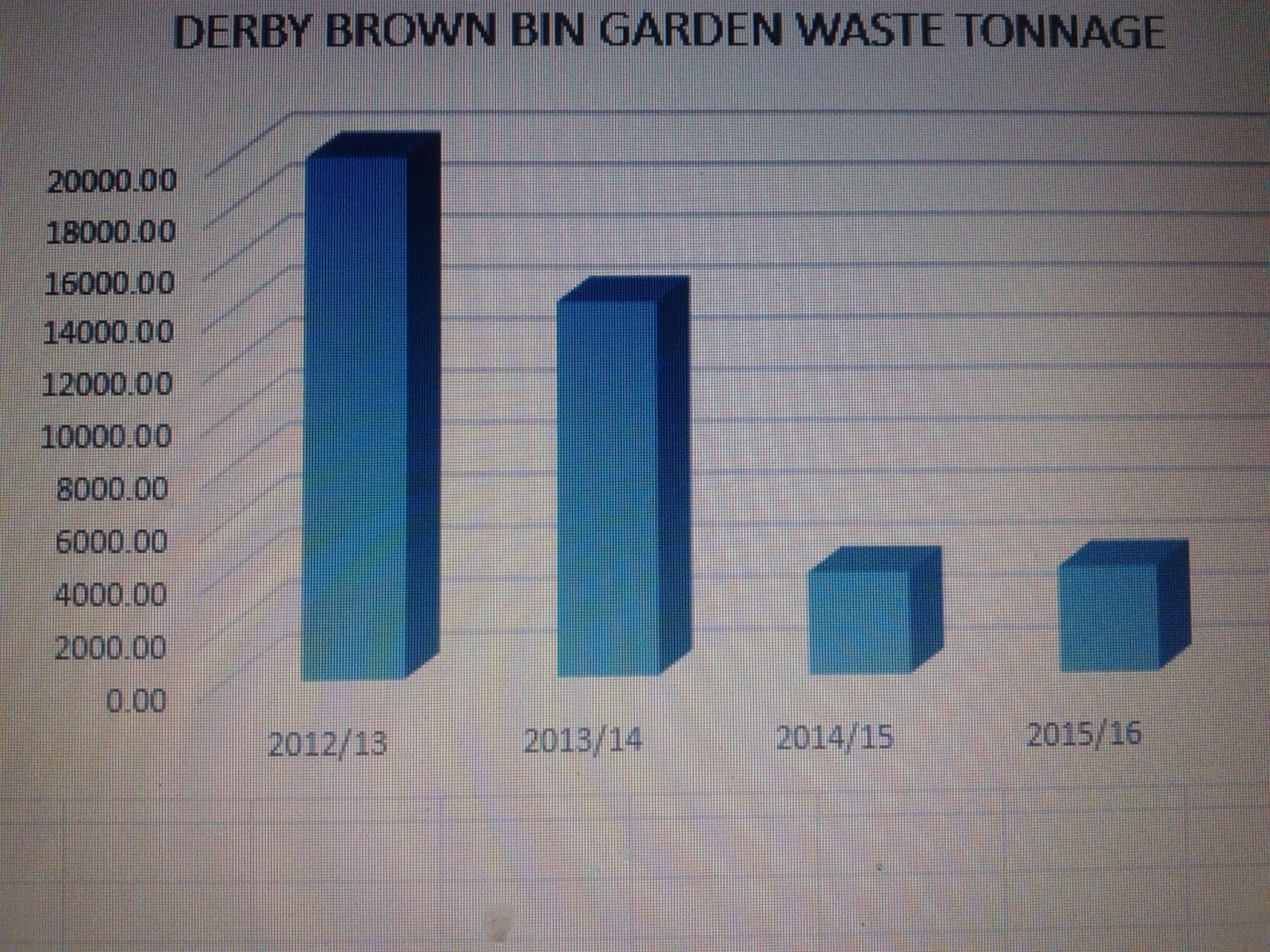
The image below shows the fall in garden waste composting via the brown bin - prior to the service termination this material included a percentage of food waste composted via the brown bin service.


The documents sourced via FOI show a planned charge of £20 per bin with £10 for the 2nd bin, this does not reflect the now applied £40 and £20 for the 2nd bin charge.
The final options appraisal further noted a charge of £20 and £10 noting this is relatively low compared to other councils.
It notes that the city will FAIL to reach the 2020 government target of recycling 50% of waste.
The council had planned to move recycling to the black bin and residual waste to the small blue bin.
The council was aiming for a 20 - 30% uptake in the chargeable garden waste collection.
A number of options were put forward for waste management – it is suggested in the documents that option 6 be selected
 
Option 6 To adopt a citywide garden waste charging policy based on 20% participation and implement a single bin comingled recycling collection service using the black bin. We would also rollout a weekly residual waste collection service using the smaller 140L blue bin
The blue bin supplied to residents has a capacity of 140 LTR which is relatively small and does not have the capacity to contain all of the recycling material currently presented at the kerbside. It is therefore proposed that the blue bin is swapped over with the black bin. The black 240 LTR bin will be used as the recycling bin and the blue bin will be used for the residual waste. A weekly residual waste collection service will be rolled out citywide.
A charging policy for the collection of garden waste is proposed which may prove unpopular with customers; however 30% of Local Authorities already charge with others coming on stream.
 This option will produce savings of £1.14m and will streamline our service delivery with the implementation of a single pass collection system for dry recyclables. This will prove very popular with our customers as they will no longer have to use red, orange and blue sacks. A weekly residual waste collection service will also prove very popular.
Recommendation
"Taking the four major factors into consideration it is recommended that Option 6 is introduced.”
The reality is NO considered option matches what has finally taken place as
 option 6 is not what actually happened.

The reality was that while the brown bin itself stayed the same, new larger blue bins were issued and small blue bins were removed. Dry recycling stayed in the blue bin and residual waste in the black bin.
FOI data showing a cost break down suddenly shows a £40 plus £20 charge for bin number 2 or more.
 No FOI papers show why this figure changed from the planned £20 and £10 charge.
The council in the FOI data consider that 20,000 residents would sign up for the £40 charge with 1 in 4 of those agreeing to pay a further £20 for a 2nd bin.
IN 2015 CUSTOMERS FOR THE BROWN BIN SCHEME STOOD AT 12,083 AND NOT THE 20,000 CUSTOMERS THE COUNCIL EXPECTED.
CONCLUSION
It is quite clear that garden and food waste was being processed far cheaper than the charge proposed and later applied and the vastly higher rate if it moves as it has done to the black bin residual route. The charge is shown in council papers to be lower than that now applied. Large volumes of waste will now be diverted from recycling and composting driving down the cities recycling rate and diverting waste to landfill and incineration and will likely be fly tipped.
They have managed to select a waste option that was not even in the options considered.
THERE IS SOMETHING ROTTEN AND IT IS NOT JUST WHAT IS PUT IN THE BROWN BIN!
 
©SIMON BACON 2017


Sunday, 28 February 2016

A game of tag thats tag the recycling bin!

When it comes to waste disposal in Derby UK there can be nothing worse than going out to fetch your bin in only to find the green tag of doom attached to the lid!


This is the tag that the council binmen attach to your bin if you have done something wrong - you may have overfilled it or you may have made it to heavy or you may have put things in you shouldn't. Don't expect the bin man to mark what the issue is - you are expected to guess what the problem is.
 
Back in 2014 I published another blog post that focused on the proposal to remove kerbside collections from areas of the city due to claims of contamination which can be viewed here http://derby-waste-a-rubbish-blog.blogspot.co.uk/2014/12/the-decay-of-recycling-in-derby.html 
 
My blog has highlighted media coverage on the subject where kerbside collections were removed in areas such as Mackworth, Arboretum and Normanton wards of the city. The justification was that bins were contaminated leading to rejection of loads by Biffa the councils recycling provider. When I exposed that loads were not being rejected shortly afterwards Biffa conveniently started rejecting material.
Back in September 2014 my FOI request number 6346 showed that the contamination rate for the city was less than 6% at 5.8% and is shown below.
 
"How many loads of blue bin recyclables have been rejected by your contractor BIFFA at its Victory Road sorting facility in 2013/14
ANSWER: None, rejects are taken out during the sorting process. The average percentage of rejected material from the start of the new blue bin collection system on June 4th 2013 to 31st March 2014 was 5.8% "

NOW REMEMBER THAT PERCENTAGE - 5.8% CONTAMINATION FOR LATER !

     Where blue bin kerbside recycling was removed the replacement service - a restricted set of bring sites just became prime hot spots for fly tipping as shown below.

 
In recent weeks once again the council bin men in the Normanton ward of the city have been tagging bins in the streets. Some for lids being left up - where people try and recycle to much !
 
 
Others for questionable amounts of incorrect materials in the bins - or contamination to use the councils words. What the council misses is when tagging the bins they put that bin into limbo. The resident doesn't not know what they have done wrong because the council does not identify the actual issue but the council also will not empty the bin until the issue is addressed. What happens is we end up blighting communities with bins in limbo where the residents don't sort the issue and the council doesn't act. Is that really the way forward to improve recycling in the city - which has crashed to around 33%?


The council cabinet member when challenged on the extended tagging of bins in Normanton said that officers would look into it and empty those tagged in error but that they needed to maintain their stance on quality of material collected - siting recent load rejection by its contractor Biffa. I have not seen any bins being reviewed in this way.
So the council have removed kerbside blue bin collections from many streets in a number of communities to help reduce recycling contamination. Lets just remember that contamination rate for 2013/14 - 5.8% so what is it now ? remove the poor recyclers and surely that rate improves further.
 
ERRRR NO!
its now
16%
 
SO IT HAS INCREASED BY OVER 10%
This is confirmed in an email last week from the cabinet member for waste Councillor Asaf Afzal where he states
"Over the last 3 reporting quarters the average contamination was 16 per cent. "
 
CLEARLY THE COUNCIL DOES NOT HAVE A GRIP ON RECYCLING IN THE CITY.


©SIMON BACON 2016
 

Tuesday, 1 December 2015

FOI - Freedom Of Information or Fear Of Informing the public

Freedom of information often known as FOI is currently a commonly used method of finding out aspects of your local councils business. We as council tax payers have a right to know what our taxes are being spent on.
It was with this in mind having noted recently that Derby City Council was facing charges from its recycler Biffa for contamination (which previously was not the case) that I set about requesting a copy of the contracts linked to the blue bin recycling scheme which I thought was a simple thing to do and expected few problems.
I asked for the following-

a copy of all current contracts relating to the blue bin material collected and its onward treatment - ie BIFFA etc.

The council had 20 working days to provide the requested information and I sat back and waited.
This is when the council started to play hard to get because on day 18 they decided they didn't know which contract I wanted and asked me to clarify this for them - I concluded this was a delaying tactic and so lodged a formal complaint - and clarified which contract I was interested in when responding to the councils FOI dept.
They then wheeled out another excuse to delay issuing what is only a contract linked to some recycling ! this time they said the following -
"In accordance with the Environmental Information Regulations 2004 - Regulation 7, Question 1 due to the volume and complexity of the request , we will need to extend the period to respond from 20 to 40 working days.  The revised deadline for our response is 21 October 2015."
So they had managed to stretch their response time to 40 days! what were they trying to hide!
Finally they gave their response - and it wasn't good news ! they partly declined to answer my requests siting commercial interests.
They said the following

"Your request has now been considered and part of the information you have requested in Question 1 is covered by an exemption under Freedom of Information.  We have attached part of the information however, in accordance with the Freedom of Information Act 2000 this part of the email acts as a part Refusal Notice.
The exemption applied is Section 43 – Commercial Interests  
We have applied this exemption because detailed costs cannot be disclosed as this would prejudice the commercial interests of both the Council and third parties.
Disclosure of this information would compromise future tenders and the cost of providing this service in the future could increase, as a result. Also, third parties could be commercially disadvantaged if their detailed pricing information was in the public domain.   
On balance we feel that the potential prejudice to the commercial interests of the Council and the other parties in disclosing this information outweighs the public interest in making it available in the public domain. It is therefore, not considered in the public interest to release this information because the cost of providing this service could increase in the future which could affect public services provided by the Council."


Now what struck me straight away was that this was a contract processing my rubbish using my money and I had a right to the facts. I already view the councils accounts so would know many of the facts they were looking to withhold.
So what did they do? well they issued a few documents relating to the processing of recyclables but then redacted large parts of the most recent correspondence between the council and Biffa - as shown below.


As you can see not only did they redact figures in the letter - which incidentally was relating to the contracts extension but also redacted whole paragraphs - so it wasn't possible to even work out what was being redacted.
These things are sent to try us but it is our right to know so there was only one thing to do - make an appeal to the council about the redaction.
If you make an FOI on a subject don't just accept the first result - they don't want to tell you their secrets so will try and fudge you with a redaction so set out why you should be issued a full copy of what you have asked for. In my case in the end I was successful when the Principal Information Governance Officer at Derby City Council found in my favour.
So what were they trying to hide? nothing more it would appear than the fact the more recycling that goes into the blue bin the less the council - and so us as residents pay via our taxes!
You would think this would be exactly what the council SHOULD be promoting to its residents - to inspire residents to recycle more but instead it hides the facts from the public by redacting aspects of the contract!
The unredacted letter appears below -

 
Why do the council fear telling the public the truth ! why do they fear FOI !

©SIMON BACON 2016


Monday, 2 February 2015

Educating Derby on rubbish is err RUBBISH!

With the current state of the streets in areas of Derby blighted by fly tipped waste, in the image below it's recyclable waste dumped on Middleton Street, Normanton

 recycling bins being removed because of claims that residents don't use them correctly http://www.derbytelegraph.co.uk/Rubbish-bins-Derby-s-green-protesters-blues/story-25756604-detail/story.html which has been questioned on this blog before due to a lack of evidence and then the dire spiral downwards of the cities recycling rate from a high of 48% to a new predicted low of 32% covered in this previous blog post http://derby-waste-a-rubbish-blog.blogspot.co.uk/2014/12/the-decay-of-recycling-in-derby.html . It would seem a simple no brainer to spend a healthy amount of the councils waste budget on waste minimisation and education.
Sadly this is not the case as a recent FOI request on the subject put into Derby City Council after I viewed the councils accounts highlighted that in total the council was spending less than £50,000 on waste minimisation and education while paying Resource Recovery Solutions - RRS (a Shanks waste company) over £8.66 million for disposal of waste and operation of the Raynesway HWRC site. Of that £8.66 million less than £34,000 was paid to RRS for minimisation and education and when added to the spend from outside of the waste contract the figure was less than £50,000.
It struck me why are we paying a waste contractor over £8 million to handle waste - much of which will end up landfilled or incinerated via a contract which cost in 2013/14 £118 per tonne when the alternatives being reduction, reuse and recycling cost £10 per tonne or less! The council keep telling us they have no money due to government cuts but they are actually preferring to handle waste via its most expensive route.
Come on its a no brainer isn't it ? every tonne extra recycled costing the council £10 or reduced - costing the council nothing is a tonne the council isn't paying £118 a tonne to dispose of.
On 28th January I went to the Full Council meeting at Derby City Council to put a public question to the council in relation to why the council is spending so much on disposal compared to educating residents.

f. Question from Simon Bacon to Councillor Afzal 

In 2013/14 Derby City Council paid Resource Recovery Solutions - a SHANKS company £8,666,724 to handle 79,995 tonnes of the waste of Derby. Of that just £33,279 was spent on waste minimisation and education and when added to non RRS spend on waste minimisation and education of £13,984 equates to spending less than £50,000 on sustainable waste management education.   
Why is Derby City Council spending so little on waste reduction while spending so much on disposal via landfill and incineration.


The response was a fair bit of waffle about what they are going to do bla bla bla but they also set out that Household waste management costs for 2012/13 published by Department of Communities and Local Government (DCLG) and reported by the Audit Commission, indicate that of £3.3 Billion spent nationally on household waste management, only £25.6 Million was spent of waste minimisation, which is less than 1% of the total national spend on household waste. Derby allocated around 0.5% of its 2013-14 waste spends on recycling and waste reduction initiatives. However, the national average cannot be considered an absolute target for spend and the city is satisfied it has got good value for money from the budget it has spent on educating its residents and young people in waste matters.

What the council is admitting there is that it spends less than the national average on waste education at a time when the streets are in a state, blue bin recycling is being removed and the recycling rate is spirally downwards.
As a follow up question I asked at a time when recycling is going so wrong in Derby is the council spending so little.
The answer came from the leader of the council Ranjit Banwait who indicated they couldn't spend more on waste education due to government cuts. What Councillor Banwait ignores in saying this is the saving that comes from educating residents on waste disposal becomes self financing due to the gulf between recycling costing £10 and residual disposal costing £118 - every tonne diverted via education saves £108 !
Landfilling and incinerating waste is rubbish ! we should be educating residents how to dispose of their waste in the correct way leading to cleaner streets, better, higher recycling rates and reduced disposal costs -
SAVING US MONEY !

©SIMON BACON 2016