Showing posts with label compost. Show all posts

Tuesday, 21 January 2020

How to save money? make someone else pay!

Back in February 2019 it was becoming clear that Derbyshire Dales District Council were proposing to remove their previously free garden waste recycling service and replace it with a charged for service just at the time that in reverse Derby City Council were returning their garden waste service to a free service in an attempt to boost the recycling service in the city.

A vast improvement in tonnage of garden waste collected has already been noted by Derby City Council in response to a recent public question at Full Council. 

Between 01/04/19 and 31/10/19 the council collected 10,264 tonnes of organic waste compared to 3,786 tonnes for the same period in 2018.
This means an increased collection of 6,478 tonnes 

So with this obvious benefit which can be seen by the results of Derby City Council why have Derbyshire Dales suddenly moved the other way? 
WELL
It could have something to do with if sly old Derbyshire Dales District Council can get residents to put their waste into the residual waste bin instead because people will say I AM NOT PAYING THAT then its happy days -
 BECAUSE DERBYSHIRE DALES DISTRICT COUNCIL DO NOT PAY FOR RESIDUAL WASTE DISPOSAL AS THAT COST IS MET BY DERBYSHIRE COUNTY COUNCIL !

You can read more about that here in my blog post from 2019 
http://derby-waste-a-rubbish-blog.blogspot.com/2019/02/something-is-rotten-in-derbyshire-dales.html

So where are we now?
Local Democracy Reporter at the Derby Telegraph newspaper Eddie Bisknell wrote a report in late December 2019 that Derbyshire Dales District Council had now agreed to apply a FIFTY POUND garden waste charge !
Eddie reports that Councillors "wished there was another option on the table" With waste disposal costs facing an increase of over £2 million the council say this cost increase Is not affordable without there being an affect on residents.
BUT
As we know by forcing garden waste into the residual waste stream it WILL impact on local residents by putting a cost pressure on the County Council instead while also making residents pay!
The charged for service begins in Spring 2021 unless prior to this the UK government put in place changes in garden waste disposal legislation. 

©SIMON BACON 2020 

Wednesday, 5 December 2018

The brown bin charge is dead! Long live free recycling!

The brown bin recycling charge has been binned in the city of Derby UK!
Turning the tide of charges for garden waste collection which is gradually crippling recycling in the UK
 (as recycling is based on weight and garden waste is a heavy component of any recycling scheme)
 
The Conservative council which was voted into power in the May local election put forward in their election manifesto a return to a free collection.
Prior to this the poor residents of the city had to pay £40 for the service which didn't even last all year!
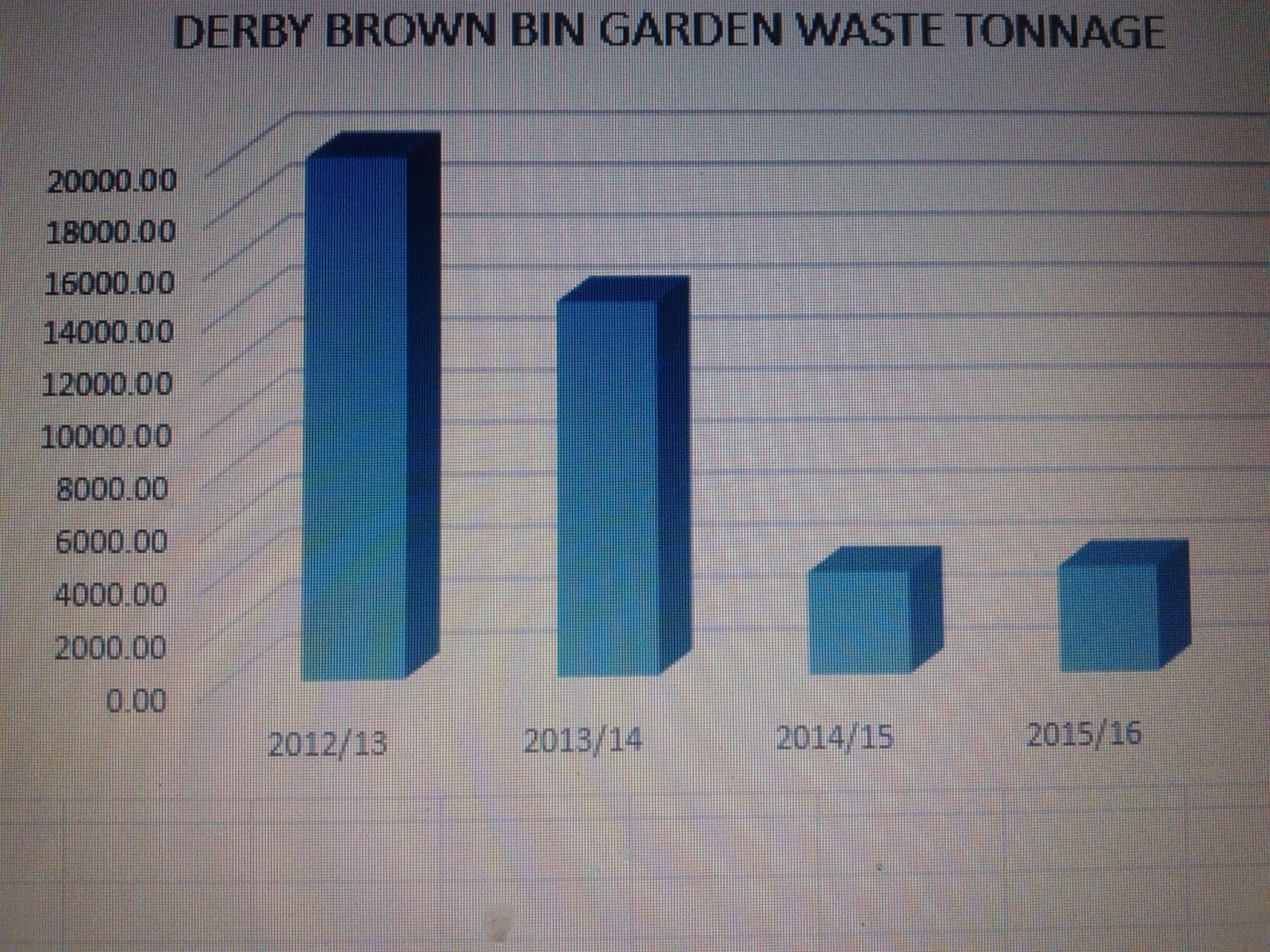
Back in 2012/13 the council collected almost 20,000 tonnes of garden and food waste which was sent for in vessel composting outside of the city via a free service.
Fast forward to 2017/18 and that tonnage had shrunk to less that 4,400 tonnes of waste composted which was clearly linked to not just the £40 charge but also the fact food waste was no longer accepted and the service was restricted to specific 32 weeks of the year.
 
The charge had devastated the recycling rate at Derby City Council and it is now hoped this will help recycling turn a corner in the city.
 
The return of food waste collections in with the garden waste collection over the full 52 week year takes us back in a positive direction which was previously removed because food waste cannot be processed in a charged for service due to government regulation.
 
Recent residual waste surveys carried out in the city by the council identified that a massive 44% of waste gathered in the cities residual waste bins was garden and food waste.
In 2017/18 the city paid just £31.53 per tonne for its garden waste to be composted in an in vessel process at Ashbourne in Derbyshire.
This compares to the same waste entering the Resource Recovery Solutions residual waste contract where total contract waste costs for 2017/18 were roughly £91.57 per tonne -
a difference of around £60.
A return to a recycling rate of 20,000 tonnes could save the council over £900,000 per year! the council could save a great deal more if it diverted the 44% of compostable garden and food waste from the residual waste bin into the brown composting bin.
Well it could but there is a catch !

Currently the residual waste is sent to be burnt in a D10 disposal gasification incineration plant in Sinfin, Derby.
The council is paying a set fee of £25 million towards the plants construction - which is hopelessly behind schedule.
The less waste that the council sends to that plant the more per tonne fee that becomes when you add the cost to the per tonne charge the council will pay.
The council has contractually agreed to send waste of specific characteristics to be burnt in Sinfin and that includes an agreement to supply waste of a minimum biodegradable content - along with other specific requirements.
The following statement from the brown bin cabinet document shows how the incineration plant contract has its claws into the garden waste recycling project.


Any reduction in biodegradable content sent by the council to the Sinfin Lane plant in Derby will be looked on in a bad way by the operator of the residual waste contract - Resource Recovery Solutions (Derbyshire) or as we know them RRS because in a twist they have been awarded ROCs - Renewable Obligation Certificates for electricity generated from the burning of the biodegradable waste - ROCs have a value and RRS will be able to bank them!
Paying a government bung for burning such waste in an inefficient disposal plant basically rewards FAILURE!

 ©SIMON BACON 2018


Sunday, 14 October 2018

BURNING COMPOSTABLE WASTE IS ROTTEN!

People who say it is good to burn compostable waste as it creates renewable energy are talking rot !
In the city of Derby UK a waste gasification incineration plant is under construction and one of the driving forces behind the development are government bungs known as ROCs for energy generated by burning biodegradable waste.
You can read more about ROCs and the Sinfin Lane waste gasification plant here-
 http://derby-waste-a-rubbish-blog.blogspot.com/2018/05/get-ya-rocs-off.html
 
Judging by the amount of odour complaints about the plant before the plant is fully operational there is certainly something rotten about the proposal.
The council in Derby changed to a Conservative administration in May 2018 and part of their electioneering was to state they would return to a free garden waste collection service - after the previous Labour council removed the free garden and food waste service which had run all year and replaced it with a charged for service (£40) for a garden waste only part year service.
With the prospect of a return to a free service brings with it the ability to also accept food waste in the cities brown bin recycling scheme. Ever since the free collection was removed the council still continued to send garden waste to Vital Earth at Ashbourne in Derbyshire which runs an in vessel composting process which produces a sterile product from garden and food waste.
The key point here however is that when there was a charged for service the council could not collect food waste in the same recycling bin because it would be considered that the council was also charging for food waste collections - which is not legal under government regulations on waste disposal. Common sense should say that the food waste was an extra to the charged for garden service - which could have been seen as good as it would have diverted biodegradable waste from landfill and incineration but here at the Rubbish Blog we don't set government regulation.
The public of Derby will now be expecting the election pledge by the now Conservative council in the city to be put in place as soon as possible and there is talk of this happening in 2019 however little evidence of this proposal is currently in the public domain.
Residual waste inspections carried out in the city in Summer 2017 have led to a better understanding of what is the composition of the waste Derby residents place in their black residual waste bins.
What we know is that around 44% of the waste heading to the Sinfin waste incineration plant is a mix of garden and food waste.
So what is likely sinking in with Derby City Council is that there is 44% of their waste being shipped to be burnt in Sinfin which could potentially be processed a lot cheaper at Vital Earth in Ashbourne where the councils garden waste was composted in 2017/18 for just £31.53 per tonne after the council got a generous rebate of £10 per tonne of waste shipped to the site.
But how can the council make use of this cheap service - which would also boost the cities recycling rate by a vast amount when they are contractually required to feed the Sinfin waste incineration plant?
They are not only required in the contract to procure waste of specific characteristics, organic content, moisture content etc but also when investing a lump sum of £25 million into the project the lower the amount of waste sent to Sinfin the higher the per tonne cost the council faces when we divide the payment by tonnage sent which then undermines the councils business case.
Almost ten years down the line with the incineration plant still not handed over not only does the plant itself stink but so does the project the council has signed up to.

©SIMON BACON 2018


Sunday, 26 February 2017

Something is rotten in the brown bin!

THE £40 BROWN BIN CHARGE 
 A LOOK BACK AT THE DECISION TO BRING IN A CHARGE FOR GARDEN WASTE IN DERBY UK.
 FIRST WRITTEN AT THE TIME THE PROPOSAL WAS PUT IN PLACE BUT NOW INCLUDES UPDATES.
         Derby told DEFRA they had in use 89,215 brown bins in 2012/13.
It isn’t clear if that includes homes who had a 2nd brown bin.
Council accountants confirmed to me that in 2012/13 19975.11 tonnes of waste was handled via the brown bin at a cost of £49.13 per tonne – As confirmed by Russell Sexton at Derby City Council.
This is a cost of £981,451.63 plus a collection cost of a claimed £880,000 as confirmed by Malcolm Price at Derby City Council via email giving a total of £1,861,451.63
If these figures are correct that produces a cost per household in the last financial year to the council of £20.86 for a full year including food waste which clearly isn’t £40 without food waste for a part year.
If we presume there are 100,000 bins as is often considered to be the case that becomes £18.61
That waste in general has to be collected whatever bin lorry collects it – once in the RRS / SHANKS residual waste contract that waste would cost at least £100 per tonne to handle – ie circa £1,997,500 WITHOUT THE COLLECTION COST.
 2015/16 costs were at least £107.40 per tonne and at a recent Full Council meeting it was quoted as £120.00 in 2016/17.
 An FOI request was made for all documents relating to the brown bin £40 charge proposal.
Documents show the council expected a 10% fall in recycling – based on the 2012/13 recycling rate of 45% will mean a plunge from 48% in 2010/11 to 35% in the future.
The 2015/16 recycling rate for the city was actually 32.3%

The image below shows the fall in garden waste composting via the brown bin - prior to the service termination this material included a percentage of food waste composted via the brown bin service.


The documents sourced via FOI show a planned charge of £20 per bin with £10 for the 2nd bin, this does not reflect the now applied £40 and £20 for the 2nd bin charge.
The final options appraisal further noted a charge of £20 and £10 noting this is relatively low compared to other councils.
It notes that the city will FAIL to reach the 2020 government target of recycling 50% of waste.
The council had planned to move recycling to the black bin and residual waste to the small blue bin.
The council was aiming for a 20 - 30% uptake in the chargeable garden waste collection.
A number of options were put forward for waste management – it is suggested in the documents that option 6 be selected
 
Option 6 To adopt a citywide garden waste charging policy based on 20% participation and implement a single bin comingled recycling collection service using the black bin. We would also rollout a weekly residual waste collection service using the smaller 140L blue bin
The blue bin supplied to residents has a capacity of 140 LTR which is relatively small and does not have the capacity to contain all of the recycling material currently presented at the kerbside. It is therefore proposed that the blue bin is swapped over with the black bin. The black 240 LTR bin will be used as the recycling bin and the blue bin will be used for the residual waste. A weekly residual waste collection service will be rolled out citywide.
A charging policy for the collection of garden waste is proposed which may prove unpopular with customers; however 30% of Local Authorities already charge with others coming on stream.
 This option will produce savings of £1.14m and will streamline our service delivery with the implementation of a single pass collection system for dry recyclables. This will prove very popular with our customers as they will no longer have to use red, orange and blue sacks. A weekly residual waste collection service will also prove very popular.
Recommendation
"Taking the four major factors into consideration it is recommended that Option 6 is introduced.”
The reality is NO considered option matches what has finally taken place as
 option 6 is not what actually happened.

The reality was that while the brown bin itself stayed the same, new larger blue bins were issued and small blue bins were removed. Dry recycling stayed in the blue bin and residual waste in the black bin.
FOI data showing a cost break down suddenly shows a £40 plus £20 charge for bin number 2 or more.
 No FOI papers show why this figure changed from the planned £20 and £10 charge.
The council in the FOI data consider that 20,000 residents would sign up for the £40 charge with 1 in 4 of those agreeing to pay a further £20 for a 2nd bin.
IN 2015 CUSTOMERS FOR THE BROWN BIN SCHEME STOOD AT 12,083 AND NOT THE 20,000 CUSTOMERS THE COUNCIL EXPECTED.
CONCLUSION
It is quite clear that garden and food waste was being processed far cheaper than the charge proposed and later applied and the vastly higher rate if it moves as it has done to the black bin residual route. The charge is shown in council papers to be lower than that now applied. Large volumes of waste will now be diverted from recycling and composting driving down the cities recycling rate and diverting waste to landfill and incineration and will likely be fly tipped.
They have managed to select a waste option that was not even in the options considered.
THERE IS SOMETHING ROTTEN AND IT IS NOT JUST WHAT IS PUT IN THE BROWN BIN!
 
©SIMON BACON 2017


Sunday, 20 March 2016

If you dont pay - Derby City Council wont take it away!

In the past the residents of Derby UK as part of their council tax payment got a free garden waste collection service allowing them to dispose of garden and food waste all year. Sent to an in-vessel composting plant (IVC) at Vital Earth in Ashbourne, Derbyshire garden and food waste was then processed in a controlled manner to produce compost and soil improver products.
You can read more about that here http://vitalearth.tv/index.html
 
Sadly in an attempt to save money - which the council maintains it has done the council removed the free service in late 2013 and replaced it with a garden waste only April - November service from 2014 onwards. To date the material continued to be sent to Vital Earth at Ashbourne but the impact on the cities recycling rate has been devastating leading to a drop to just 32.9% for the year 2014/15 from a high of 48% in 2010/11.
The killer part of this is the service is no longer free costing £40 per service year with any further bins costing £20 for collection. The council expected to gain 20,000 customers by 2015 for the service but only gained 12,083 customers.
 
There are other options to consider and those include taking your garden waste to the Household Waste Recycling Centre (HWRC) site at Raynesway but this is not always convenient compared to a kerbside collection and on weekend days it is known that the site rapidly develops a long queue winding its way out to the main road - another example of the council not considering all the issues when implementing their money saving plan! To find out more about Raynesway HWRC site take a look here http://www.derby.gov.uk/environment-and-planning/recycling-rubbish-and-waste/recycling-sites/

But wouldn't it be better to take control of your own garden and food waste and to turn it into a free usable compost and soil improver to use at home in your garden? why spend £40 a year on a garden waste collection that does not last all year and does not accept food waste when you could spend that money on a compost bin or even just on materials to make your own compost bin that fits into your own garden.
Take my home example!
 
in my case I use an old garden incinerator which holds a reasonable volume of garden waste for a small garden and has air holes to allow your composting process to breathe! Holes in the container are open to debate but personally I like to have a few - plus in this case I was reusing a 2nd hand container.


When composting it is important to allow the heap to breathe by keeping the mix open to some degree. Don't just fill your heap with grass clippings and other squishy green material, try and make a blend of greenery from your house and garden mixed with some drier woodier materials - which can include paper and card, tissue, shredded paper etc which may in themselves not be ideal for recycling if they are shredded or contain some food contamination for example.
 
As part of a mix they can play a key role in making your compost a success.
 
Be careful when composting certain materials such as weeds and veg peelings because unlike an in-vessel composting plant which reaches high temperatures ideal for killing off perennial weed roots, seeds and things such as potato peelings which try and sprout a home composter may not reach the required temperature to kill off these more aggressive items. You don't want to spread your new compost on the garden only to find every weed seed germinates so try not to put large perennial weed routes in the compost bin or seed heads containing viable seeds. Another important thing to remember is the mix often needs some water to give all the beneficial bacteria the right damp environment to start munching all that garden waste.

For larger gardens you may well need more than one compost bin as the composting process can be a long job and you don't want to find your full up half way through the year!
 
So when is the compost ready you may ask - and thats a good question!
 
 A general rule of thumb is when the material is crumbly and black and you can no longer identify what it was before composting then its usually ready to use. Don't be surprised if the mix still contains some degree of twiggy material as this is not a problem if you are using the compost as a soil improver where it is dug in to improve soil structure and increase nutrient levels.
One thing to note is the term compost! compost can mean more than one thing and leads to confusion and errors when growing plants. You basically have compost you purchase from a shop which will be a blend of suitable materials and fertilisers and is suitable to use on a range of plants. Then you have compost from your compost heap which might better be described as soil conditioner or soil improver because its main use is as the name suggests is to improve the gardens soil structure while adding nutrients - it can be dug in or used as a mulch around plants and the best bit being its FREE!
 
Now you COULD also make use of it as a compost for potting but that is when greater care is needed as often the compost from your heap is to rich to be used on its own and it is common practice to blend it with other materials such as loam and leaf mould so as to make a more stable useable material. You basically have to experiment a bit if you want to use it for such uses.
 
What you can do with your newly produced compost is to run it through a garden sieve to grade out all the bigger material - returning it to further compost leaving you with a rich fine mixture which if kept out of the rain can be used when ever you want to plant in your garden.
 
 
The compost can then be applied to your garden to aid drainage, hold water in dry weather and provide nutrients and beneficial bacteria to aid plant growth.
 
 
You can find out lots more from the internet regarding composting but a fine place to start is here
 
 
©SIMON BACON 2016