Showing posts with label composting. Show all posts

Tuesday, 21 January 2020

How to save money? make someone else pay!

Back in February 2019 it was becoming clear that Derbyshire Dales District Council were proposing to remove their previously free garden waste recycling service and replace it with a charged for service just at the time that in reverse Derby City Council were returning their garden waste service to a free service in an attempt to boost the recycling service in the city.

A vast improvement in tonnage of garden waste collected has already been noted by Derby City Council in response to a recent public question at Full Council. 

Between 01/04/19 and 31/10/19 the council collected 10,264 tonnes of organic waste compared to 3,786 tonnes for the same period in 2018.
This means an increased collection of 6,478 tonnes 

So with this obvious benefit which can be seen by the results of Derby City Council why have Derbyshire Dales suddenly moved the other way? 
WELL
It could have something to do with if sly old Derbyshire Dales District Council can get residents to put their waste into the residual waste bin instead because people will say I AM NOT PAYING THAT then its happy days -
 BECAUSE DERBYSHIRE DALES DISTRICT COUNCIL DO NOT PAY FOR RESIDUAL WASTE DISPOSAL AS THAT COST IS MET BY DERBYSHIRE COUNTY COUNCIL !

You can read more about that here in my blog post from 2019 
http://derby-waste-a-rubbish-blog.blogspot.com/2019/02/something-is-rotten-in-derbyshire-dales.html

So where are we now?
Local Democracy Reporter at the Derby Telegraph newspaper Eddie Bisknell wrote a report in late December 2019 that Derbyshire Dales District Council had now agreed to apply a FIFTY POUND garden waste charge !
Eddie reports that Councillors "wished there was another option on the table" With waste disposal costs facing an increase of over £2 million the council say this cost increase Is not affordable without there being an affect on residents.
BUT
As we know by forcing garden waste into the residual waste stream it WILL impact on local residents by putting a cost pressure on the County Council instead while also making residents pay!
The charged for service begins in Spring 2021 unless prior to this the UK government put in place changes in garden waste disposal legislation. 

©SIMON BACON 2020 

Monday, 18 February 2019

Something is rotten in the Derbyshire Dales.

Across the UK many councils are now looking to charge for garden waste be it for an all year or part year service an example of which until recently is Derby UK where a part year service was £40 for garden waste to be collected April to November.
The result of the Derby charge for service was a devastated recycling rate and so thankfully Derby City Council have seen sense and a free service restarts in April 2019.
  No sooner do we get this good news from Derby in relation to the garden waste service returning to a free service do we get the bad news from Derbyshire Dales District Council that they are proposing to INTRODUCE  a charged for service claiming that they could not continue their free service to residents once they negotiate their new waste recycling contract.
Now there is a key difference between the two councils because while Derby City Council is a disposal authority meaning it has to fund all of its waste and recycling Derbyshire Dales is just a district council and while it has to fund its recycling service it does not have to fund its residual waste disposal which is a key difference between the two councils.
The proposal to introduce a charged for service in the Derbyshire Dales area was enthusiastically welcomed by many councillors at a council meeting in late 2018 on 29th November. There was talk of the councils recycling rate being at 57% and recent government publications suggest it could even be as high as 60% which is an impressive recycling rate but once a charged for service for garden waste is put in place where will that rate go other than down in a spiral ?
The councils recycling rate uses tonnage of recycling as the method for generating the councils recycling rate and as garden waste is a heavy material removal of that waste from the recycling stream clearly reduces the overall tonnage of recyclate and that has to then impact the councils recycling rate of which they are so proud.
Then we have to consider the slight of hand that's going to take place here at Derbyshire Dales District Council when it comes to waste costs linked to recycling and disposal.
Derbyshire Dales District Council is simply a district council and has to pay the cost of collecting waste and recycling waste materials but what it does NOT have to do is pay for the disposal of residual waste because that is the responsibility of Derbyshire County Council which is the disposal authority.
All Derbyshire Dales District Council has to do is collect and deliver residual waste to where Derbyshire County Council directs them towards which could either be directly to the controversial Sinfin waste incineration plant in Derby or to a transfer site in the county for onward shipment to Sinfin to be burnt.
Now its not rocket science to realise that if your a district council looking to reduce costs if you can force waste you were previously paying to compost into the residual waste stream that you DON'T pay to dispose of and even better get people to agree to pay a charge for the waste that still does get composted then by some wonder of wonders you have saved your council money but what you are not doing is saving your residents money because by diverting compostable waste into the residual waste stream which is very commonly vastly more expensive per tonne than if composted you have transferred a cost to the disposal authority which in this case is Derbyshire County Council which in turn will have to recoup that increased cost from residents of the County via the likes of an increase in council tax.
There may however be a happy ending to this story!
In recent days the UK government have announced proposals that they will require councils to offer a free garden waste service so the plans of Derbyshire Dales District Council may still be consigned to the compost heap!

 ©SIMON BACON 2019

Sunday, 26 February 2017

Something is rotten in the brown bin!

THE £40 BROWN BIN CHARGE 
 A LOOK BACK AT THE DECISION TO BRING IN A CHARGE FOR GARDEN WASTE IN DERBY UK.
 FIRST WRITTEN AT THE TIME THE PROPOSAL WAS PUT IN PLACE BUT NOW INCLUDES UPDATES.
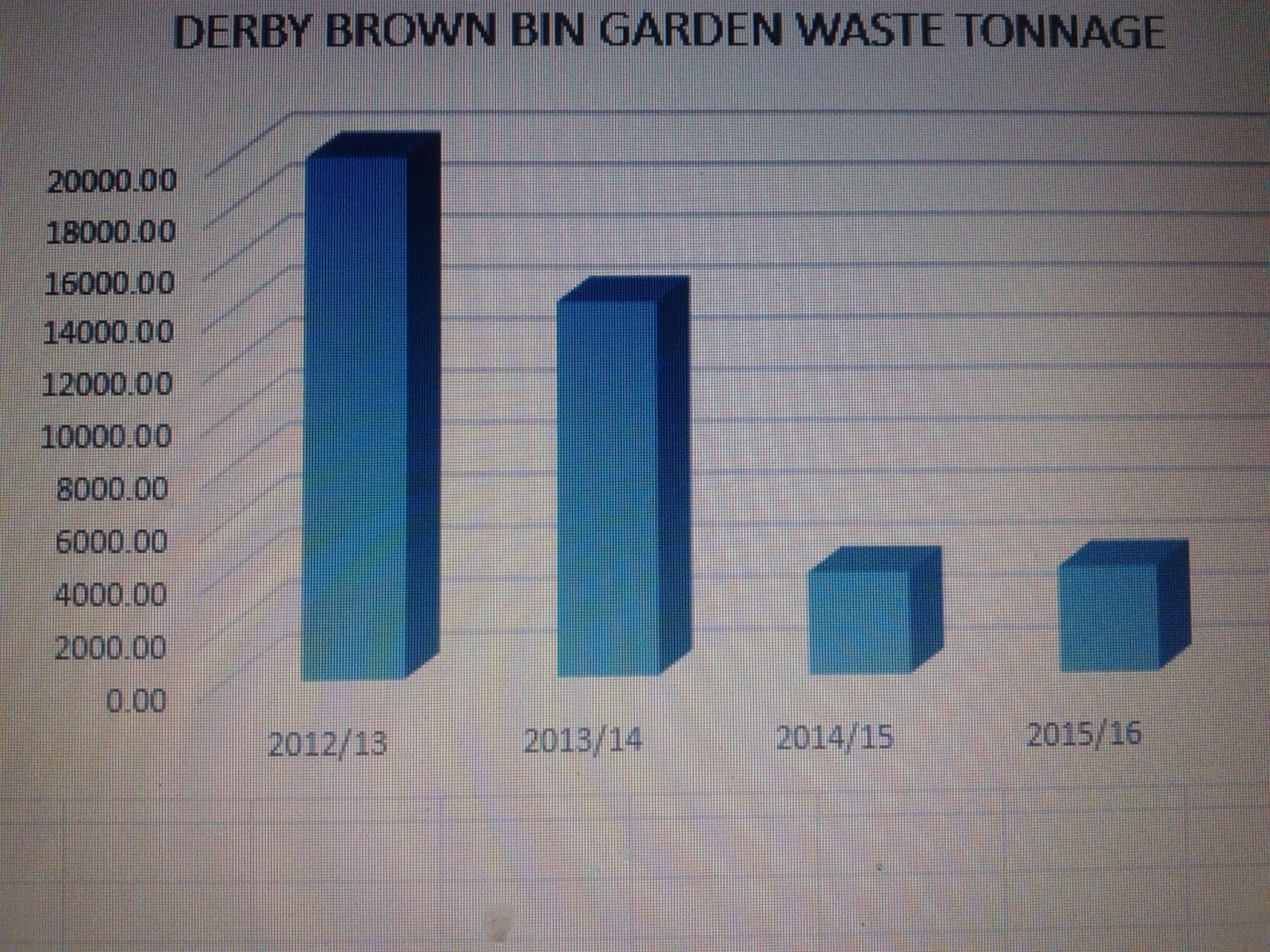
         Derby told DEFRA they had in use 89,215 brown bins in 2012/13.
It isn’t clear if that includes homes who had a 2nd brown bin.
Council accountants confirmed to me that in 2012/13 19975.11 tonnes of waste was handled via the brown bin at a cost of £49.13 per tonne – As confirmed by Russell Sexton at Derby City Council.
This is a cost of £981,451.63 plus a collection cost of a claimed £880,000 as confirmed by Malcolm Price at Derby City Council via email giving a total of £1,861,451.63
If these figures are correct that produces a cost per household in the last financial year to the council of £20.86 for a full year including food waste which clearly isn’t £40 without food waste for a part year.
If we presume there are 100,000 bins as is often considered to be the case that becomes £18.61
That waste in general has to be collected whatever bin lorry collects it – once in the RRS / SHANKS residual waste contract that waste would cost at least £100 per tonne to handle – ie circa £1,997,500 WITHOUT THE COLLECTION COST.
 2015/16 costs were at least £107.40 per tonne and at a recent Full Council meeting it was quoted as £120.00 in 2016/17.
 An FOI request was made for all documents relating to the brown bin £40 charge proposal.
Documents show the council expected a 10% fall in recycling – based on the 2012/13 recycling rate of 45% will mean a plunge from 48% in 2010/11 to 35% in the future.
The 2015/16 recycling rate for the city was actually 32.3%

The image below shows the fall in garden waste composting via the brown bin - prior to the service termination this material included a percentage of food waste composted via the brown bin service.


The documents sourced via FOI show a planned charge of £20 per bin with £10 for the 2nd bin, this does not reflect the now applied £40 and £20 for the 2nd bin charge.
The final options appraisal further noted a charge of £20 and £10 noting this is relatively low compared to other councils.
It notes that the city will FAIL to reach the 2020 government target of recycling 50% of waste.
The council had planned to move recycling to the black bin and residual waste to the small blue bin.
The council was aiming for a 20 - 30% uptake in the chargeable garden waste collection.
A number of options were put forward for waste management – it is suggested in the documents that option 6 be selected
 
Option 6 To adopt a citywide garden waste charging policy based on 20% participation and implement a single bin comingled recycling collection service using the black bin. We would also rollout a weekly residual waste collection service using the smaller 140L blue bin
The blue bin supplied to residents has a capacity of 140 LTR which is relatively small and does not have the capacity to contain all of the recycling material currently presented at the kerbside. It is therefore proposed that the blue bin is swapped over with the black bin. The black 240 LTR bin will be used as the recycling bin and the blue bin will be used for the residual waste. A weekly residual waste collection service will be rolled out citywide.
A charging policy for the collection of garden waste is proposed which may prove unpopular with customers; however 30% of Local Authorities already charge with others coming on stream.
 This option will produce savings of £1.14m and will streamline our service delivery with the implementation of a single pass collection system for dry recyclables. This will prove very popular with our customers as they will no longer have to use red, orange and blue sacks. A weekly residual waste collection service will also prove very popular.
Recommendation
"Taking the four major factors into consideration it is recommended that Option 6 is introduced.”
The reality is NO considered option matches what has finally taken place as
 option 6 is not what actually happened.

The reality was that while the brown bin itself stayed the same, new larger blue bins were issued and small blue bins were removed. Dry recycling stayed in the blue bin and residual waste in the black bin.
FOI data showing a cost break down suddenly shows a £40 plus £20 charge for bin number 2 or more.
 No FOI papers show why this figure changed from the planned £20 and £10 charge.
The council in the FOI data consider that 20,000 residents would sign up for the £40 charge with 1 in 4 of those agreeing to pay a further £20 for a 2nd bin.
IN 2015 CUSTOMERS FOR THE BROWN BIN SCHEME STOOD AT 12,083 AND NOT THE 20,000 CUSTOMERS THE COUNCIL EXPECTED.
CONCLUSION
It is quite clear that garden and food waste was being processed far cheaper than the charge proposed and later applied and the vastly higher rate if it moves as it has done to the black bin residual route. The charge is shown in council papers to be lower than that now applied. Large volumes of waste will now be diverted from recycling and composting driving down the cities recycling rate and diverting waste to landfill and incineration and will likely be fly tipped.
They have managed to select a waste option that was not even in the options considered.
THERE IS SOMETHING ROTTEN AND IT IS NOT JUST WHAT IS PUT IN THE BROWN BIN!
 
©SIMON BACON 2017


Wednesday, 1 June 2016

Would you like flies with that?

After a number of years use and ownership by Transcycle - including acting as a hub for the city of Derby's brown bin recycling scheme where garden and food waste was bulked up for shipment to Vital Earth at Ashbourne for composting number 201 Slack Lane in the New Zealand / Mackworth area of the city was placed on the market.
The community have had issues with the site in the past as sited in an inner city area odour and fly issues were always likely to be on residents minds. Few likely noted the small article in the Derby Telegraph in the late summer of 2015 reporting that a new company was moving to Derby from Nottingham and was known as Go 4 Greener Waste Management. Taking on the 2.6 acre site the company owned by Wayne and Sam Turton was described as a business providing a range of recycling services.
Deeds logged with the land registry indicate the Turton's are owners of the site having paid £850,000 in July 2015 with the support of Barclays Bank.
While described in the media at the time as offering recycling services the companies website talks of zero waste to landfill - which to those in anti incineration circles means sending waste to incineration plants in either the UK or Europe. The Go 4 Greener twitter account in the past made reference to agreeing waste disposal contracts with AEB Amsterdam - a major incinerator of waste so it is clear that the company does not just handle specific recyclables but clearly has an interest in waste of a more residual nature - but then that needs to be shipped in some fashion to the likes of AEB Amsterdam. Tweets from 2014 show their engagement with AEB Amsterdam.

This then brings us to the issue that has unfolded in the streets and homes of the Mackworth community in recent weeks and months. While buzzing along under the radar for some time in recent weeks a serious fly outbreak has blighted the community bringing misery and distress to all around including major impacts on the Kingsway Retail Park leading to store closures.
Many pages of the complex story of what has happened and who is to blame have been printed or reported in recent weeks with fingers being pointed in different directions by different parties.
Without a copy of the waste permit it is not possible to identify what the site should and should not handle but what we do know is that the waste permit itself is registered not to Go 4 Greener but to another company owned by the Turton's known as Shows Waste Management which was launched in 2015. Waste permits are the life blood of a waste site - it is what allows the process to take place and these permits are issued by the Environment Agency.
The Turton's via the media appear to be suggesting that the issues relating to the flies on the site and the surrounding area are due to who they call Envirofuels / Trent Valley Recycling who it is claimed they leased part of the site to although the media report that the companies in question deny these claims.
Independent news reporter Derby News recently published an article on the waste saga shedding light on company ownership and the article can be found here
https://derbynews.org.uk/2016/05/27/mackworth-fly-infestation-convenient-confusion-over-whos-to-blame/

The facts with this situation are all pretty murky as to who is responsible for the waste in question but suggestions are circulating that issues with the site were raised at a residents meeting as far back as February 2016 and if this is the case potentially dates back beyond the involvement with these companies. This is backed up by the fact the Environment Agency issued an order against Shows Waste Management on March 10th 2016 which is before Trent Valley Recycling signed the agreement to use the site.
This has led to the site being filled with large bales on the site of what could potentially be refuse derived fuel - known as RDF - shown below.
 
As to what the bales actually contain and their intended destination if they are in fact RDF bales then they could have been produced by either one of the Turton's companies - noting their connections to incineration plants in Holland or that of fledgling company Enviro Fuels Solutions Ltd who appear to be the company the Turton's are referring to.
What is becoming clear is that neither Derby City Council or the Environment Agency are making Shows Waste Management deal with the waste in the time scale locals need to get the fly infestation under control. In recent days a representative of the Environment Agency on East Midlands Today appeared to be implying that in part the issue was linked to homes being built around the site but anyone who knows the area knows that many of the local homes date back decades and in some cases around a century.
The Go 4 Greener website makes some grand claims about the companies ethos so lets hope they stand by them in the coming weeks and deal with the situation that is playing our in the city of Derby.
 
 
There are many unanswered questions in this terrible situation but one that makes you stop and wonder is the following.
 
If you run a waste company and have spent £850,000 on a site and you have an active waste permit in your companies name placing you in the position of overall control and therefore liability why would you risk your business by allowing the serious situation to develop on the site which is now causing such local distress and directly placing your business and family life at risk?
If as suggested in the media there is 5,000 tonnes of waste that needs to be landfilled based just on the landfill tax rate of £84.40 the Turton's face a bill of over £400,000 for disposal of the waste mountain.
 
The latest twist to the saga is that the Environment Agency have started legal action against companies on the site in relation to the waste. How this will pan out is anyone's guess but things need to improve soon for the good of the local community.
 
©SIMON BACON 2016


Sunday, 20 March 2016

If you dont pay - Derby City Council wont take it away!

In the past the residents of Derby UK as part of their council tax payment got a free garden waste collection service allowing them to dispose of garden and food waste all year. Sent to an in-vessel composting plant (IVC) at Vital Earth in Ashbourne, Derbyshire garden and food waste was then processed in a controlled manner to produce compost and soil improver products.
You can read more about that here http://vitalearth.tv/index.html
 
Sadly in an attempt to save money - which the council maintains it has done the council removed the free service in late 2013 and replaced it with a garden waste only April - November service from 2014 onwards. To date the material continued to be sent to Vital Earth at Ashbourne but the impact on the cities recycling rate has been devastating leading to a drop to just 32.9% for the year 2014/15 from a high of 48% in 2010/11.
The killer part of this is the service is no longer free costing £40 per service year with any further bins costing £20 for collection. The council expected to gain 20,000 customers by 2015 for the service but only gained 12,083 customers.
 
There are other options to consider and those include taking your garden waste to the Household Waste Recycling Centre (HWRC) site at Raynesway but this is not always convenient compared to a kerbside collection and on weekend days it is known that the site rapidly develops a long queue winding its way out to the main road - another example of the council not considering all the issues when implementing their money saving plan! To find out more about Raynesway HWRC site take a look here http://www.derby.gov.uk/environment-and-planning/recycling-rubbish-and-waste/recycling-sites/

But wouldn't it be better to take control of your own garden and food waste and to turn it into a free usable compost and soil improver to use at home in your garden? why spend £40 a year on a garden waste collection that does not last all year and does not accept food waste when you could spend that money on a compost bin or even just on materials to make your own compost bin that fits into your own garden.
Take my home example!
 
in my case I use an old garden incinerator which holds a reasonable volume of garden waste for a small garden and has air holes to allow your composting process to breathe! Holes in the container are open to debate but personally I like to have a few - plus in this case I was reusing a 2nd hand container.


When composting it is important to allow the heap to breathe by keeping the mix open to some degree. Don't just fill your heap with grass clippings and other squishy green material, try and make a blend of greenery from your house and garden mixed with some drier woodier materials - which can include paper and card, tissue, shredded paper etc which may in themselves not be ideal for recycling if they are shredded or contain some food contamination for example.
 
As part of a mix they can play a key role in making your compost a success.
 
Be careful when composting certain materials such as weeds and veg peelings because unlike an in-vessel composting plant which reaches high temperatures ideal for killing off perennial weed roots, seeds and things such as potato peelings which try and sprout a home composter may not reach the required temperature to kill off these more aggressive items. You don't want to spread your new compost on the garden only to find every weed seed germinates so try not to put large perennial weed routes in the compost bin or seed heads containing viable seeds. Another important thing to remember is the mix often needs some water to give all the beneficial bacteria the right damp environment to start munching all that garden waste.

For larger gardens you may well need more than one compost bin as the composting process can be a long job and you don't want to find your full up half way through the year!
 
So when is the compost ready you may ask - and thats a good question!
 
 A general rule of thumb is when the material is crumbly and black and you can no longer identify what it was before composting then its usually ready to use. Don't be surprised if the mix still contains some degree of twiggy material as this is not a problem if you are using the compost as a soil improver where it is dug in to improve soil structure and increase nutrient levels.
One thing to note is the term compost! compost can mean more than one thing and leads to confusion and errors when growing plants. You basically have compost you purchase from a shop which will be a blend of suitable materials and fertilisers and is suitable to use on a range of plants. Then you have compost from your compost heap which might better be described as soil conditioner or soil improver because its main use is as the name suggests is to improve the gardens soil structure while adding nutrients - it can be dug in or used as a mulch around plants and the best bit being its FREE!
 
Now you COULD also make use of it as a compost for potting but that is when greater care is needed as often the compost from your heap is to rich to be used on its own and it is common practice to blend it with other materials such as loam and leaf mould so as to make a more stable useable material. You basically have to experiment a bit if you want to use it for such uses.
 
What you can do with your newly produced compost is to run it through a garden sieve to grade out all the bigger material - returning it to further compost leaving you with a rich fine mixture which if kept out of the rain can be used when ever you want to plant in your garden.
 
 
The compost can then be applied to your garden to aid drainage, hold water in dry weather and provide nutrients and beneficial bacteria to aid plant growth.
 
 
You can find out lots more from the internet regarding composting but a fine place to start is here
 
 
©SIMON BACON 2016