Showing posts with label garden. Show all posts

Tuesday, 21 January 2020

How to save money? make someone else pay!

Back in February 2019 it was becoming clear that Derbyshire Dales District Council were proposing to remove their previously free garden waste recycling service and replace it with a charged for service just at the time that in reverse Derby City Council were returning their garden waste service to a free service in an attempt to boost the recycling service in the city.

A vast improvement in tonnage of garden waste collected has already been noted by Derby City Council in response to a recent public question at Full Council. 

Between 01/04/19 and 31/10/19 the council collected 10,264 tonnes of organic waste compared to 3,786 tonnes for the same period in 2018.
This means an increased collection of 6,478 tonnes 

So with this obvious benefit which can be seen by the results of Derby City Council why have Derbyshire Dales suddenly moved the other way? 
WELL
It could have something to do with if sly old Derbyshire Dales District Council can get residents to put their waste into the residual waste bin instead because people will say I AM NOT PAYING THAT then its happy days -
 BECAUSE DERBYSHIRE DALES DISTRICT COUNCIL DO NOT PAY FOR RESIDUAL WASTE DISPOSAL AS THAT COST IS MET BY DERBYSHIRE COUNTY COUNCIL !

You can read more about that here in my blog post from 2019 
http://derby-waste-a-rubbish-blog.blogspot.com/2019/02/something-is-rotten-in-derbyshire-dales.html

So where are we now?
Local Democracy Reporter at the Derby Telegraph newspaper Eddie Bisknell wrote a report in late December 2019 that Derbyshire Dales District Council had now agreed to apply a FIFTY POUND garden waste charge !
Eddie reports that Councillors "wished there was another option on the table" With waste disposal costs facing an increase of over £2 million the council say this cost increase Is not affordable without there being an affect on residents.
BUT
As we know by forcing garden waste into the residual waste stream it WILL impact on local residents by putting a cost pressure on the County Council instead while also making residents pay!
The charged for service begins in Spring 2021 unless prior to this the UK government put in place changes in garden waste disposal legislation. 

©SIMON BACON 2020 

Tuesday, 15 October 2019

The plant pot that went to Full Council !

Single use plastic in the many forms it now comes in is a hot topic across the globe as it blocks rivers, streams and beaches. News is published it seems daily of one risk or other to wildlife and the human race and this focus is now bringing change - or at least it is when those trying to change are supported by those locally in power who can support and aid change.

When it comes to single use plastics if they cannot be designed out then they must at the very least be recyclable AND collected for recycling. There is little point in making a product recyclable if the infrastructure is not there to handle the product at end of life so that it can once again be returned as a resource to the manufacturers to complete the recycling circle.

A prime example of a single use plastic item which currently struggles to be recycled are plastic plant pots which can be found in almost all gardens across the UK as the public carry out the yearly ritual of planting out summer flowers. Many of these pots are made from polypropylene often called PP for short. Recycling should not be an issue as this plastic is already widely recycled in the UK when gathered in the recycling stream of household materials but there is a problem and that problem is that most of the plant pots are made from black polypropylene and as many of us know black plastic can rarely be sorted at UK materials recycling facilities because the sorting machines cannot see black plastics.


As single use plastics became more of a media story and as TV programs such as Gardeners World began to focus on the issue change began to take place in horticulture as pot manufacturers began producing alternative pots in specific shades which are now beginning to catch on. Taupe and blue are just two shades of recyclable plant pots now being sold into the horticultural industry.

It was with this in mind and with being employed in horticulture where I have spoken to many concerned customers that I decided I needed to take this up directly with my local council and so back in February 2019 a blue recyclable plant pot made by the manufacturer Poppelmann under their TEKU brand made it's way to the council chamber in Derby UK where I asked on it's behalf if the council would now finally accept such plant pots for recycling in the cities co-mingled waste recycling scheme.


.....
So that was a NO at that point but after the meeting I continued to push the issue of accepting recyclable plant pots by continuing to engage with the council cabinet member and staff from the councils recycling dept in Derby. They were provided with information directly from the manufacturers website
I thought having provided the manufacturers specific information on the product it would answer all the councils questions along with those of their current recycling processor Biffa Waste Services who would be the ones actually sorting and selling on the material.

One of the main sticking points claimed by the council was that Biffa their current contractor was concerned about the plant pots being contaminated with soil which they felt was a bacteria risk. Now this could be considered a risk if all the OTHER plastics collected by the council were clean and sterile but as we all know in the real world they are far from clean and likely carry just as many if not more bacteria of concern so to me this is just a fob off because the plastic in question does not have a high value. Lets face it plastics will be cleaned prior to being melted down so the councils contractor faces few risks. 
As someone who has worked with such scary soil daily in my work in horticulture it sounds like I am lucky to be alive if we trust the council and their contractor Biffa's concerns!

To take this blog post full circle I felt it only fair to once again ask the council about the potential for plant pot recycling having given them a number of months to digest my request.

Council cabinet member for waste Councillor Jonathan Smale stated the following.

" We are continuing to work with our suppliers to extend the offer to residents around recycling, we will continue this process with our future contacts as well.  At present under the current contract we cannot accept these materials, however, this is all being looked at with our new contract.

With regards to the consultant we are working with for the re-tendering of the dry recyclable and garden waste contracts, this consultant is Eunomia. We are also hoping DEFRA gives us some clear direction on the future waste strategy."


We can only hope that the councils advisers and DEFRA push the likes of Derby City Council in the direction of plant pot recycling instead of the potty idea that plant pot recycling is something to fear. 


©SIMON BACON 2019


Monday, 18 February 2019

Something is rotten in the Derbyshire Dales.

Across the UK many councils are now looking to charge for garden waste be it for an all year or part year service an example of which until recently is Derby UK where a part year service was £40 for garden waste to be collected April to November.
The result of the Derby charge for service was a devastated recycling rate and so thankfully Derby City Council have seen sense and a free service restarts in April 2019.
  No sooner do we get this good news from Derby in relation to the garden waste service returning to a free service do we get the bad news from Derbyshire Dales District Council that they are proposing to INTRODUCE  a charged for service claiming that they could not continue their free service to residents once they negotiate their new waste recycling contract.
Now there is a key difference between the two councils because while Derby City Council is a disposal authority meaning it has to fund all of its waste and recycling Derbyshire Dales is just a district council and while it has to fund its recycling service it does not have to fund its residual waste disposal which is a key difference between the two councils.
The proposal to introduce a charged for service in the Derbyshire Dales area was enthusiastically welcomed by many councillors at a council meeting in late 2018 on 29th November. There was talk of the councils recycling rate being at 57% and recent government publications suggest it could even be as high as 60% which is an impressive recycling rate but once a charged for service for garden waste is put in place where will that rate go other than down in a spiral ?
The councils recycling rate uses tonnage of recycling as the method for generating the councils recycling rate and as garden waste is a heavy material removal of that waste from the recycling stream clearly reduces the overall tonnage of recyclate and that has to then impact the councils recycling rate of which they are so proud.
Then we have to consider the slight of hand that's going to take place here at Derbyshire Dales District Council when it comes to waste costs linked to recycling and disposal.
Derbyshire Dales District Council is simply a district council and has to pay the cost of collecting waste and recycling waste materials but what it does NOT have to do is pay for the disposal of residual waste because that is the responsibility of Derbyshire County Council which is the disposal authority.
All Derbyshire Dales District Council has to do is collect and deliver residual waste to where Derbyshire County Council directs them towards which could either be directly to the controversial Sinfin waste incineration plant in Derby or to a transfer site in the county for onward shipment to Sinfin to be burnt.
Now its not rocket science to realise that if your a district council looking to reduce costs if you can force waste you were previously paying to compost into the residual waste stream that you DON'T pay to dispose of and even better get people to agree to pay a charge for the waste that still does get composted then by some wonder of wonders you have saved your council money but what you are not doing is saving your residents money because by diverting compostable waste into the residual waste stream which is very commonly vastly more expensive per tonne than if composted you have transferred a cost to the disposal authority which in this case is Derbyshire County Council which in turn will have to recoup that increased cost from residents of the County via the likes of an increase in council tax.
There may however be a happy ending to this story!
In recent days the UK government have announced proposals that they will require councils to offer a free garden waste service so the plans of Derbyshire Dales District Council may still be consigned to the compost heap!

 ©SIMON BACON 2019

Wednesday, 5 December 2018

The brown bin charge is dead! Long live free recycling!

The brown bin recycling charge has been binned in the city of Derby UK!
Turning the tide of charges for garden waste collection which is gradually crippling recycling in the UK
 (as recycling is based on weight and garden waste is a heavy component of any recycling scheme)
 
The Conservative council which was voted into power in the May local election put forward in their election manifesto a return to a free collection.
Prior to this the poor residents of the city had to pay £40 for the service which didn't even last all year!
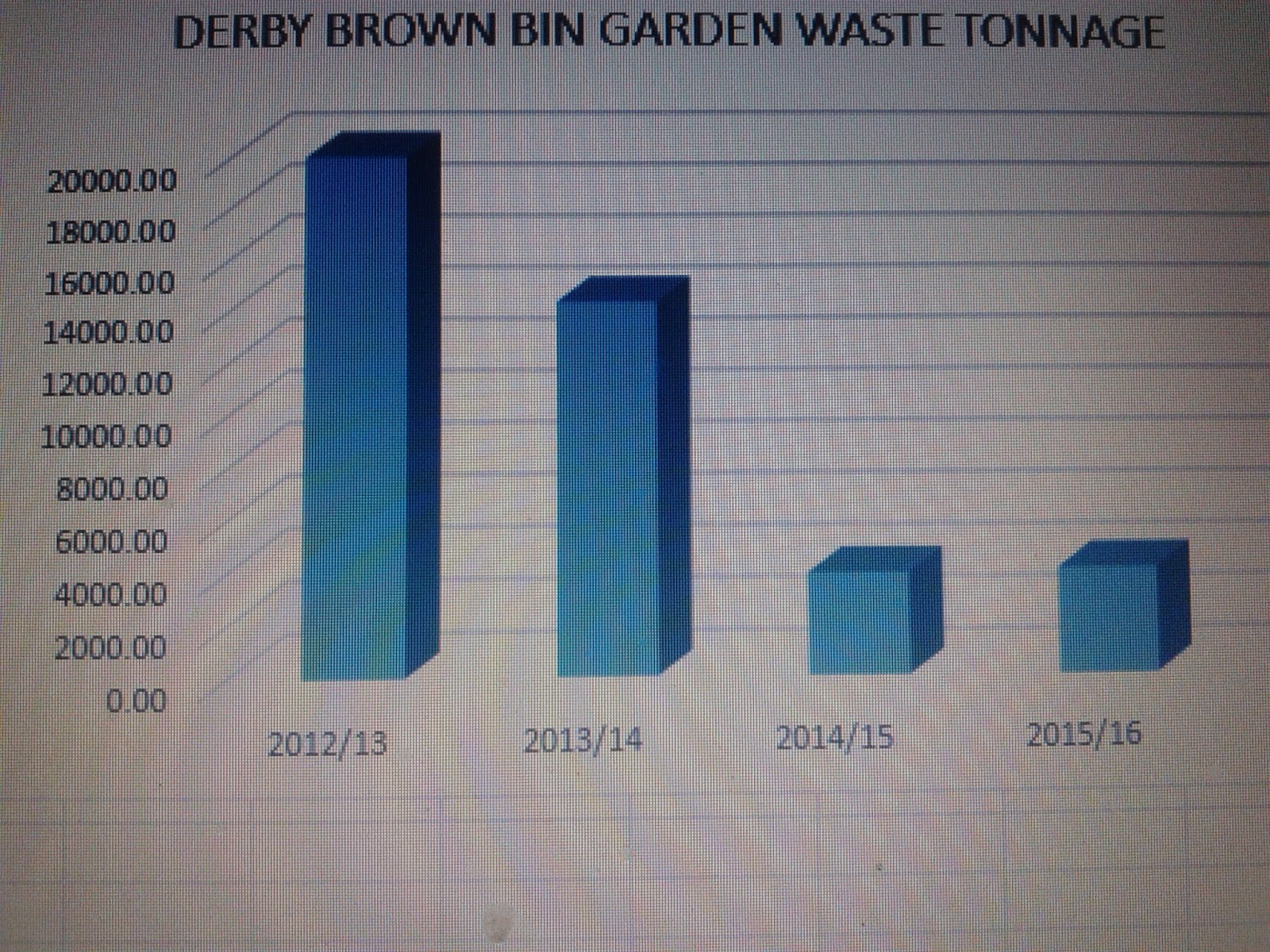
Back in 2012/13 the council collected almost 20,000 tonnes of garden and food waste which was sent for in vessel composting outside of the city via a free service.
Fast forward to 2017/18 and that tonnage had shrunk to less that 4,400 tonnes of waste composted which was clearly linked to not just the £40 charge but also the fact food waste was no longer accepted and the service was restricted to specific 32 weeks of the year.
 
The charge had devastated the recycling rate at Derby City Council and it is now hoped this will help recycling turn a corner in the city.
 
The return of food waste collections in with the garden waste collection over the full 52 week year takes us back in a positive direction which was previously removed because food waste cannot be processed in a charged for service due to government regulation.
 
Recent residual waste surveys carried out in the city by the council identified that a massive 44% of waste gathered in the cities residual waste bins was garden and food waste.
In 2017/18 the city paid just £31.53 per tonne for its garden waste to be composted in an in vessel process at Ashbourne in Derbyshire.
This compares to the same waste entering the Resource Recovery Solutions residual waste contract where total contract waste costs for 2017/18 were roughly £91.57 per tonne -
a difference of around £60.
A return to a recycling rate of 20,000 tonnes could save the council over £900,000 per year! the council could save a great deal more if it diverted the 44% of compostable garden and food waste from the residual waste bin into the brown composting bin.
Well it could but there is a catch !

Currently the residual waste is sent to be burnt in a D10 disposal gasification incineration plant in Sinfin, Derby.
The council is paying a set fee of £25 million towards the plants construction - which is hopelessly behind schedule.
The less waste that the council sends to that plant the more per tonne fee that becomes when you add the cost to the per tonne charge the council will pay.
The council has contractually agreed to send waste of specific characteristics to be burnt in Sinfin and that includes an agreement to supply waste of a minimum biodegradable content - along with other specific requirements.
The following statement from the brown bin cabinet document shows how the incineration plant contract has its claws into the garden waste recycling project.


Any reduction in biodegradable content sent by the council to the Sinfin Lane plant in Derby will be looked on in a bad way by the operator of the residual waste contract - Resource Recovery Solutions (Derbyshire) or as we know them RRS because in a twist they have been awarded ROCs - Renewable Obligation Certificates for electricity generated from the burning of the biodegradable waste - ROCs have a value and RRS will be able to bank them!
Paying a government bung for burning such waste in an inefficient disposal plant basically rewards FAILURE!

 ©SIMON BACON 2018


Sunday, 18 March 2018

IT'S GLOBAL RECYCLING DAY 2018

IT'S GLOBAL RECYCLING DAY FOLKS - SUNDAY 18TH MARCH 218
So it would be rude not to take a look at Derby City Council who are busily promoting this day on their twitter feed.
Let's take a look at the city and its recent exposure on the BBC News website regarding the fall in recycling in 14 million homes in the UK.
When considering league tables usually the higher you, your team OR in this case your local council are towards the top of the league this is considered better - its the target.  But when that league table is a table of FAILING councils and in this case the decline in the councils ability to recycle the last thing you want is to be at the top of your league!
In recent weeks the BBC has published an article about household waste recycling rates
 
RECYCLING RATE FALLS FOR 14 MILLION HOMES IN ENGLAND!
 
 
This is an in depth report into the fall in recycling rates in England and can be read here
 
What the article highlights is that Derby - the home of this blog had the 2nd biggest decline in recycling between 2011/12 and 2016/17 and the articles graph on this subject is reproduced here please visit the link above to read the full story.
 
Source - BBC NEWS
 
What this shows is that Derby came second only to Hartlepool when it came to the collapse in recycling. If the data was pushed back to 2010/11 that collapse would be even greater. For a wider look at recycling rates in Derby the image below sets out recycling right back to 2005/6.
 
 
What the graph above shows is that the 2016/17 recycling rate was actually lower than the 2007/8 rate for recycling meaning in the course of the last nine years in Derby UK we got nowhere!
The BBC article reports how Derby city council stated-
"its recycling rates had fallen after it made changes to its recycling collection services in 2014, but said rates had increased in the past two years.
It said it had taken away "kerbside blue bin recycling" from some areas of the city "due to high levels of contamination" but was "reaching out" to people who had put the non-recyclable rubbish in the wrong bin."
 
The reality is that the councils recycling service started to decline after a peak of 48% in 2010/11 which was prior to changes made by the council.
The introduction of a controversial garden waste charge scheme led to high volumes of previously recycled garden and food waste being diverted into the residual black bin. Recycling rates are based on weight and so garden and food waste play a key part in recycling schemes.
Although this slaughtered the councils recycling rate they also removed recycling from large areas of the city claiming residents contaminated their recycling bins. The BBC article implies that the council said it was reaching out to people who had put the non recyclable rubbish in the wrong bin.
It is not clear what the council is trying to do by making such claims - a recent FOI / EIR request confirmed that circa 9,000 properties did not have a kerbside recycling collection and it should also be noted that the bring sites installed as replacements are being removed due to them becoming fly tip grot spots. The council removed the blue bin recycling service - they are not reaching out to anyone and recently refused my requests for the service to be returned to the communities now new Public Protection Officers are working in the city to address bins on streets etc
You can read more about that here
 
It may be #GlobalRecyclingDay but here in Derby UK the council is top of the league in excuses as to WHY their recycling is so poor. 


 ©SIMON BACON 2018

Sunday, 26 February 2017

Something is rotten in the brown bin!

THE £40 BROWN BIN CHARGE 
 A LOOK BACK AT THE DECISION TO BRING IN A CHARGE FOR GARDEN WASTE IN DERBY UK.
 FIRST WRITTEN AT THE TIME THE PROPOSAL WAS PUT IN PLACE BUT NOW INCLUDES UPDATES.
         Derby told DEFRA they had in use 89,215 brown bins in 2012/13.
It isn’t clear if that includes homes who had a 2nd brown bin.
Council accountants confirmed to me that in 2012/13 19975.11 tonnes of waste was handled via the brown bin at a cost of £49.13 per tonne – As confirmed by Russell Sexton at Derby City Council.
This is a cost of £981,451.63 plus a collection cost of a claimed £880,000 as confirmed by Malcolm Price at Derby City Council via email giving a total of £1,861,451.63
If these figures are correct that produces a cost per household in the last financial year to the council of £20.86 for a full year including food waste which clearly isn’t £40 without food waste for a part year.
If we presume there are 100,000 bins as is often considered to be the case that becomes £18.61
That waste in general has to be collected whatever bin lorry collects it – once in the RRS / SHANKS residual waste contract that waste would cost at least £100 per tonne to handle – ie circa £1,997,500 WITHOUT THE COLLECTION COST.
 2015/16 costs were at least £107.40 per tonne and at a recent Full Council meeting it was quoted as £120.00 in 2016/17.
 An FOI request was made for all documents relating to the brown bin £40 charge proposal.
Documents show the council expected a 10% fall in recycling – based on the 2012/13 recycling rate of 45% will mean a plunge from 48% in 2010/11 to 35% in the future.
The 2015/16 recycling rate for the city was actually 32.3%

The image below shows the fall in garden waste composting via the brown bin - prior to the service termination this material included a percentage of food waste composted via the brown bin service.


The documents sourced via FOI show a planned charge of £20 per bin with £10 for the 2nd bin, this does not reflect the now applied £40 and £20 for the 2nd bin charge.
The final options appraisal further noted a charge of £20 and £10 noting this is relatively low compared to other councils.
It notes that the city will FAIL to reach the 2020 government target of recycling 50% of waste.
The council had planned to move recycling to the black bin and residual waste to the small blue bin.
The council was aiming for a 20 - 30% uptake in the chargeable garden waste collection.
A number of options were put forward for waste management – it is suggested in the documents that option 6 be selected
 
“Option 6 To adopt a citywide garden waste charging policy based on 20% participation and implement a single bin comingled recycling collection service using the black bin. We would also rollout a weekly residual waste collection service using the smaller 140L blue bin
The blue bin supplied to residents has a capacity of 140 LTR which is relatively small and does not have the capacity to contain all of the recycling material currently presented at the kerbside. It is therefore proposed that the blue bin is swapped over with the black bin. The black 240 LTR bin will be used as the recycling bin and the blue bin will be used for the residual waste. A weekly residual waste collection service will be rolled out citywide.
A charging policy for the collection of garden waste is proposed which may prove unpopular with customers; however 30% of Local Authorities already charge with others coming on stream.
 This option will produce savings of £1.14m and will streamline our service delivery with the implementation of a single pass collection system for dry recyclables. This will prove very popular with our customers as they will no longer have to use red, orange and blue sacks. A weekly residual waste collection service will also prove very popular.
Recommendation
"Taking the four major factors into consideration it is recommended that Option 6 is introduced.”
The reality is NO considered option matches what has finally taken place as
 option 6 is not what actually happened.

The reality was that while the brown bin itself stayed the same, new larger blue bins were issued and small blue bins were removed. Dry recycling stayed in the blue bin and residual waste in the black bin.
FOI data showing a cost break down suddenly shows a £40 plus £20 charge for bin number 2 or more.
 No FOI papers show why this figure changed from the planned £20 and £10 charge.
The council in the FOI data consider that 20,000 residents would sign up for the £40 charge with 1 in 4 of those agreeing to pay a further £20 for a 2nd bin.
IN 2015 CUSTOMERS FOR THE BROWN BIN SCHEME STOOD AT 12,083 AND NOT THE 20,000 CUSTOMERS THE COUNCIL EXPECTED.
CONCLUSION
It is quite clear that garden and food waste was being processed far cheaper than the charge proposed and later applied and the vastly higher rate if it moves as it has done to the black bin residual route. The charge is shown in council papers to be lower than that now applied. Large volumes of waste will now be diverted from recycling and composting driving down the cities recycling rate and diverting waste to landfill and incineration and will likely be fly tipped.
They have managed to select a waste option that was not even in the options considered.
THERE IS SOMETHING ROTTEN AND IT IS NOT JUST WHAT IS PUT IN THE BROWN BIN!
 
©SIMON BACON 2017