Showing posts with label Council. Show all posts

Tuesday, 21 January 2020

How to save money? make someone else pay!

Back in February 2019 it was becoming clear that Derbyshire Dales District Council were proposing to remove their previously free garden waste recycling service and replace it with a charged for service just at the time that in reverse Derby City Council were returning their garden waste service to a free service in an attempt to boost the recycling service in the city.

A vast improvement in tonnage of garden waste collected has already been noted by Derby City Council in response to a recent public question at Full Council. 

Between 01/04/19 and 31/10/19 the council collected 10,264 tonnes of organic waste compared to 3,786 tonnes for the same period in 2018.
This means an increased collection of 6,478 tonnes 

So with this obvious benefit which can be seen by the results of Derby City Council why have Derbyshire Dales suddenly moved the other way? 
WELL
It could have something to do with if sly old Derbyshire Dales District Council can get residents to put their waste into the residual waste bin instead because people will say I AM NOT PAYING THAT then its happy days -
 BECAUSE DERBYSHIRE DALES DISTRICT COUNCIL DO NOT PAY FOR RESIDUAL WASTE DISPOSAL AS THAT COST IS MET BY DERBYSHIRE COUNTY COUNCIL !

You can read more about that here in my blog post from 2019 
http://derby-waste-a-rubbish-blog.blogspot.com/2019/02/something-is-rotten-in-derbyshire-dales.html

So where are we now?
Local Democracy Reporter at the Derby Telegraph newspaper Eddie Bisknell wrote a report in late December 2019 that Derbyshire Dales District Council had now agreed to apply a FIFTY POUND garden waste charge !
Eddie reports that Councillors "wished there was another option on the table" With waste disposal costs facing an increase of over £2 million the council say this cost increase Is not affordable without there being an affect on residents.
BUT
As we know by forcing garden waste into the residual waste stream it WILL impact on local residents by putting a cost pressure on the County Council instead while also making residents pay!
The charged for service begins in Spring 2021 unless prior to this the UK government put in place changes in garden waste disposal legislation. 

©SIMON BACON 2020 

Tuesday, 15 October 2019

The plant pot that went to Full Council !

Single use plastic in the many forms it now comes in is a hot topic across the globe as it blocks rivers, streams and beaches. News is published it seems daily of one risk or other to wildlife and the human race and this focus is now bringing change - or at least it is when those trying to change are supported by those locally in power who can support and aid change.

When it comes to single use plastics if they cannot be designed out then they must at the very least be recyclable AND collected for recycling. There is little point in making a product recyclable if the infrastructure is not there to handle the product at end of life so that it can once again be returned as a resource to the manufacturers to complete the recycling circle.

A prime example of a single use plastic item which currently struggles to be recycled are plastic plant pots which can be found in almost all gardens across the UK as the public carry out the yearly ritual of planting out summer flowers. Many of these pots are made from polypropylene often called PP for short. Recycling should not be an issue as this plastic is already widely recycled in the UK when gathered in the recycling stream of household materials but there is a problem and that problem is that most of the plant pots are made from black polypropylene and as many of us know black plastic can rarely be sorted at UK materials recycling facilities because the sorting machines cannot see black plastics.


As single use plastics became more of a media story and as TV programs such as Gardeners World began to focus on the issue change began to take place in horticulture as pot manufacturers began producing alternative pots in specific shades which are now beginning to catch on. Taupe and blue are just two shades of recyclable plant pots now being sold into the horticultural industry.

It was with this in mind and with being employed in horticulture where I have spoken to many concerned customers that I decided I needed to take this up directly with my local council and so back in February 2019 a blue recyclable plant pot made by the manufacturer Poppelmann under their TEKU brand made it's way to the council chamber in Derby UK where I asked on it's behalf if the council would now finally accept such plant pots for recycling in the cities co-mingled waste recycling scheme.


.....
So that was a NO at that point but after the meeting I continued to push the issue of accepting recyclable plant pots by continuing to engage with the council cabinet member and staff from the councils recycling dept in Derby. They were provided with information directly from the manufacturers website
I thought having provided the manufacturers specific information on the product it would answer all the councils questions along with those of their current recycling processor Biffa Waste Services who would be the ones actually sorting and selling on the material.

One of the main sticking points claimed by the council was that Biffa their current contractor was concerned about the plant pots being contaminated with soil which they felt was a bacteria risk. Now this could be considered a risk if all the OTHER plastics collected by the council were clean and sterile but as we all know in the real world they are far from clean and likely carry just as many if not more bacteria of concern so to me this is just a fob off because the plastic in question does not have a high value. Lets face it plastics will be cleaned prior to being melted down so the councils contractor faces few risks. 
As someone who has worked with such scary soil daily in my work in horticulture it sounds like I am lucky to be alive if we trust the council and their contractor Biffa's concerns!

To take this blog post full circle I felt it only fair to once again ask the council about the potential for plant pot recycling having given them a number of months to digest my request.

Council cabinet member for waste Councillor Jonathan Smale stated the following.

We are continuing to work with our suppliers to extend the offer to residents around recycling, we will continue this process with our future contacts as well.  At present under the current contract we cannot accept these materials, however, this is all being looked at with our new contract.

With regards to the consultant we are working with for the re-tendering of the dry recyclable and garden waste contracts, this consultant is Eunomia. We are also hoping DEFRA gives us some clear direction on the future waste strategy."


We can only hope that the councils advisers and DEFRA push the likes of Derby City Council in the direction of plant pot recycling instead of the potty idea that plant pot recycling is something to fear. 


©SIMON BACON 2019


Monday, 18 February 2019

Something is rotten in the Derbyshire Dales.

Across the UK many councils are now looking to charge for garden waste be it for an all year or part year service an example of which until recently is Derby UK where a part year service was £40 for garden waste to be collected April to November.
The result of the Derby charge for service was a devastated recycling rate and so thankfully Derby City Council have seen sense and a free service restarts in April 2019.
  No sooner do we get this good news from Derby in relation to the garden waste service returning to a free service do we get the bad news from Derbyshire Dales District Council that they are proposing to INTRODUCE  a charged for service claiming that they could not continue their free service to residents once they negotiate their new waste recycling contract.
Now there is a key difference between the two councils because while Derby City Council is a disposal authority meaning it has to fund all of its waste and recycling Derbyshire Dales is just a district council and while it has to fund its recycling service it does not have to fund its residual waste disposal which is a key difference between the two councils.
The proposal to introduce a charged for service in the Derbyshire Dales area was enthusiastically welcomed by many councillors at a council meeting in late 2018 on 29th November. There was talk of the councils recycling rate being at 57% and recent government publications suggest it could even be as high as 60% which is an impressive recycling rate but once a charged for service for garden waste is put in place where will that rate go other than down in a spiral ?
The councils recycling rate uses tonnage of recycling as the method for generating the councils recycling rate and as garden waste is a heavy material removal of that waste from the recycling stream clearly reduces the overall tonnage of recyclate and that has to then impact the councils recycling rate of which they are so proud.
Then we have to consider the slight of hand that's going to take place here at Derbyshire Dales District Council when it comes to waste costs linked to recycling and disposal.
Derbyshire Dales District Council is simply a district council and has to pay the cost of collecting waste and recycling waste materials but what it does NOT have to do is pay for the disposal of residual waste because that is the responsibility of Derbyshire County Council which is the disposal authority.
All Derbyshire Dales District Council has to do is collect and deliver residual waste to where Derbyshire County Council directs them towards which could either be directly to the controversial Sinfin waste incineration plant in Derby or to a transfer site in the county for onward shipment to Sinfin to be burnt.
Now its not rocket science to realise that if your a district council looking to reduce costs if you can force waste you were previously paying to compost into the residual waste stream that you DON'T pay to dispose of and even better get people to agree to pay a charge for the waste that still does get composted then by some wonder of wonders you have saved your council money but what you are not doing is saving your residents money because by diverting compostable waste into the residual waste stream which is very commonly vastly more expensive per tonne than if composted you have transferred a cost to the disposal authority which in this case is Derbyshire County Council which in turn will have to recoup that increased cost from residents of the County via the likes of an increase in council tax.
There may however be a happy ending to this story!
In recent days the UK government have announced proposals that they will require councils to offer a free garden waste service so the plans of Derbyshire Dales District Council may still be consigned to the compost heap!

 ©SIMON BACON 2019

Wednesday, 5 December 2018

The brown bin charge is dead! Long live free recycling!

The brown bin recycling charge has been binned in the city of Derby UK!
Turning the tide of charges for garden waste collection which is gradually crippling recycling in the UK
 (as recycling is based on weight and garden waste is a heavy component of any recycling scheme)
 
The Conservative council which was voted into power in the May local election put forward in their election manifesto a return to a free collection.
Prior to this the poor residents of the city had to pay £40 for the service which didn't even last all year!
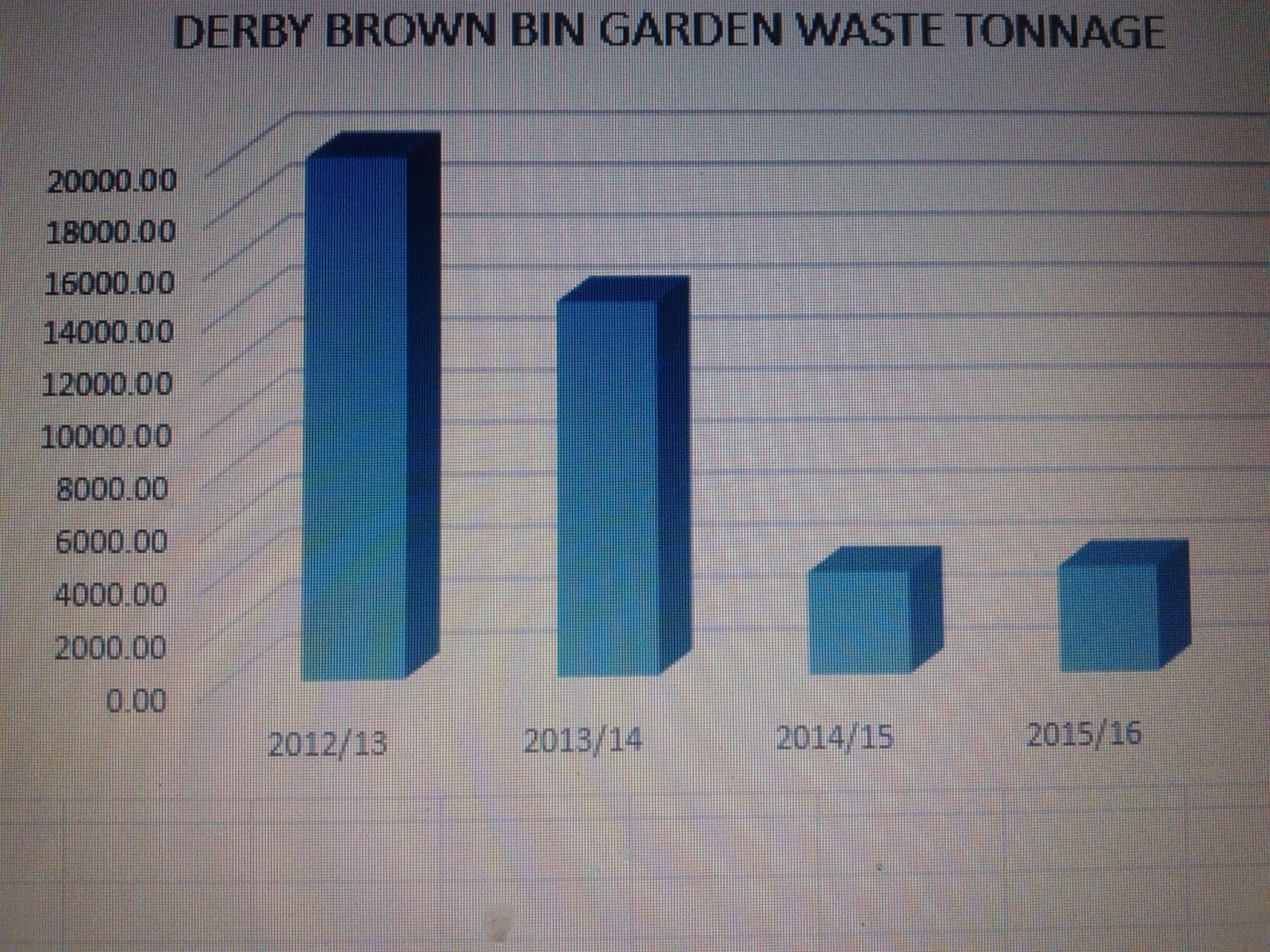
Back in 2012/13 the council collected almost 20,000 tonnes of garden and food waste which was sent for in vessel composting outside of the city via a free service.
Fast forward to 2017/18 and that tonnage had shrunk to less that 4,400 tonnes of waste composted which was clearly linked to not just the £40 charge but also the fact food waste was no longer accepted and the service was restricted to specific 32 weeks of the year.
 
The charge had devastated the recycling rate at Derby City Council and it is now hoped this will help recycling turn a corner in the city.
 
The return of food waste collections in with the garden waste collection over the full 52 week year takes us back in a positive direction which was previously removed because food waste cannot be processed in a charged for service due to government regulation.
 
Recent residual waste surveys carried out in the city by the council identified that a massive 44% of waste gathered in the cities residual waste bins was garden and food waste.
In 2017/18 the city paid just £31.53 per tonne for its garden waste to be composted in an in vessel process at Ashbourne in Derbyshire.
This compares to the same waste entering the Resource Recovery Solutions residual waste contract where total contract waste costs for 2017/18 were roughly £91.57 per tonne -
a difference of around £60.
A return to a recycling rate of 20,000 tonnes could save the council over £900,000 per year! the council could save a great deal more if it diverted the 44% of compostable garden and food waste from the residual waste bin into the brown composting bin.
Well it could but there is a catch !

Currently the residual waste is sent to be burnt in a D10 disposal gasification incineration plant in Sinfin, Derby.
The council is paying a set fee of £25 million towards the plants construction - which is hopelessly behind schedule.
The less waste that the council sends to that plant the more per tonne fee that becomes when you add the cost to the per tonne charge the council will pay.
The council has contractually agreed to send waste of specific characteristics to be burnt in Sinfin and that includes an agreement to supply waste of a minimum biodegradable content - along with other specific requirements.
The following statement from the brown bin cabinet document shows how the incineration plant contract has its claws into the garden waste recycling project.


Any reduction in biodegradable content sent by the council to the Sinfin Lane plant in Derby will be looked on in a bad way by the operator of the residual waste contract - Resource Recovery Solutions (Derbyshire) or as we know them RRS because in a twist they have been awarded ROCs - Renewable Obligation Certificates for electricity generated from the burning of the biodegradable waste - ROCs have a value and RRS will be able to bank them!
Paying a government bung for burning such waste in an inefficient disposal plant basically rewards FAILURE!

 ©SIMON BACON 2018


Sunday, 14 October 2018

BURNING COMPOSTABLE WASTE IS ROTTEN!

People who say it is good to burn compostable waste as it creates renewable energy are talking rot !
In the city of Derby UK a waste gasification incineration plant is under construction and one of the driving forces behind the development are government bungs known as ROCs for energy generated by burning biodegradable waste.
You can read more about ROCs and the Sinfin Lane waste gasification plant here-
 http://derby-waste-a-rubbish-blog.blogspot.com/2018/05/get-ya-rocs-off.html
 
Judging by the amount of odour complaints about the plant before the plant is fully operational there is certainly something rotten about the proposal.
The council in Derby changed to a Conservative administration in May 2018 and part of their electioneering was to state they would return to a free garden waste collection service - after the previous Labour council removed the free garden and food waste service which had run all year and replaced it with a charged for service (£40) for a garden waste only part year service.
With the prospect of a return to a free service brings with it the ability to also accept food waste in the cities brown bin recycling scheme. Ever since the free collection was removed the council still continued to send garden waste to Vital Earth at Ashbourne in Derbyshire which runs an in vessel composting process which produces a sterile product from garden and food waste.
The key point here however is that when there was a charged for service the council could not collect food waste in the same recycling bin because it would be considered that the council was also charging for food waste collections - which is not legal under government regulations on waste disposal. Common sense should say that the food waste was an extra to the charged for garden service - which could have been seen as good as it would have diverted biodegradable waste from landfill and incineration but here at the Rubbish Blog we don't set government regulation.
The public of Derby will now be expecting the election pledge by the now Conservative council in the city to be put in place as soon as possible and there is talk of this happening in 2019 however little evidence of this proposal is currently in the public domain.
Residual waste inspections carried out in the city in Summer 2017 have led to a better understanding of what is the composition of the waste Derby residents place in their black residual waste bins.
What we know is that around 44% of the waste heading to the Sinfin waste incineration plant is a mix of garden and food waste.
So what is likely sinking in with Derby City Council is that there is 44% of their waste being shipped to be burnt in Sinfin which could potentially be processed a lot cheaper at Vital Earth in Ashbourne where the councils garden waste was composted in 2017/18 for just £31.53 per tonne after the council got a generous rebate of £10 per tonne of waste shipped to the site.
But how can the council make use of this cheap service - which would also boost the cities recycling rate by a vast amount when they are contractually required to feed the Sinfin waste incineration plant?
They are not only required in the contract to procure waste of specific characteristics, organic content, moisture content etc but also when investing a lump sum of £25 million into the project the lower the amount of waste sent to Sinfin the higher the per tonne cost the council faces when we divide the payment by tonnage sent which then undermines the councils business case.
Almost ten years down the line with the incineration plant still not handed over not only does the plant itself stink but so does the project the council has signed up to.

©SIMON BACON 2018


Monday, 7 May 2018

Get ya ROCs off!

On April 30th 2018 Resource Recovery Solutions Derbyshire Ltd (RRS) announced that their controversial waste gasification incineration plant had been granted ROCs - Renewable Obligation Certificates for the electrical energy they will produce from the biodegradable aspect of household waste which the plant will take in for burning.
Renewi one of the parent companies of RRS released a press release relating to the granting of ROCs to the Sinfin Lane, Derby project which contain quite a degree of hot air.
They stated that "Up to 98% of the residual waste managed at the facility will be diverted from landfill, which will also generate enough green electricity to power approximately 14,000 homes."
While the plant may generate enough electricity for 14,000 homes - that is yet to be shown one thing is for sure - an unconfirmed percentage of the power generated will come not from so called green electricity - which is considered by the likes of OFGEM as biodegradable wastes being combusted but in fact non biodegradable waste such as plastics - ie fossil fuels.
It is fact (confirmed via FOI/EIR) that in the city of Derby 9,000 properties have no recycling scheme in place - after Derby City Council removed the service stating recycling bin contamination as an excuse.
What this means is that a percentage of waste entering the Sinfin facility will have had no prior recycling applied to it. Paper and card should have been recycled removing it from the residual waste stream entering the Sinfin site in Derby. Instead such material is condemned to be burnt to generate OFGEM funded electricity via ROC payments - ROCs being funded from green charges applied to our energy bills.
Has recycling been removed in the city to procure suitable waste to generate lucrative ROC payments?

Someone called James Priestley said the following-


James Priestley, Managing Director of Renewi’s Municipal Division, said:


 “We are delighted to have been awarded this important ROCs accreditation which is another significant milestone achieved in this project. Not only does this accreditation bring financial support to the project, it also shows how we are using innovative technologies to operate sustainably, divert waste from landfill and create valuable products from waste. We are looking forward to completing the final stages of commissioning and to providing first class, sustainable waste services for the people of Derby and Derbyshire.”
  Now when you use the terms innovative and first class you think ground breaking and efficient and you could be forgiven for thinking this applied in the Derby projects case but the reality is somewhat different.
At the second public inquiry into the project the planning inspector required RRS to provide evidence of their projects energy efficiency status - an important aspect of the project which was a useful insight into the project.

At the second public inquiry RRS were forced to admit that
 in the plants standard electricity only mode their plant was in fact nothing more than what is known as a D10 disposal plant because the energy efficiency status of the process falls below that which would class the plant as an efficient recovery process.

 
To see what the Waste Framework Directive says about a plant being recovery R1 or disposal D10 below is a series of quotes from the directive.

Recovery or disposal – the meaning of R1

47. The Waste Framework Directive (WFD) sets out the waste hierarchy and enshrines it in law. It requires that a waste management route defined as recovery should be used ahead of an alternative that is classified as disposal. Exceptions can be made (see below) but this general principle makes it important to know whether a process is considered recovery or disposal. 

48. Historically the Waste Framework Directives have included annexes which set out lists of what are considered to be recovery or disposal operations. Each is given a number and a letter: R for recovery, D for disposal. In the current directive the classifications of particular relevance to energy from waste are: • R1 – Use principally as a fuel or other means to generate energy • D10 – Incineration on land 

49. What this means is that where waste is burnt as a fuel to generate energy it can potentially be considered a recovery operation (R1) but where the purpose of incineration is to get rid of waste, it is considered D10 and hence disposal.  All municipal waste incinerators were and are deemed as disposal activities (D10) unless and until they are shown to meet the requirements of R1. This is why the term R1 often crops up in the debate about how good an energy from waste plant might be and how it compares to other options. 

50. For municipal solid waste, which includes all the waste collected from households, the EU has gone further by defining what it considers to be sufficient for recovery status under R1. The WFD includes a formula relating to the efficiency of the combustion plant. A municipal waste combustion plant can only be considered to be a recovery operation under R1 if it generates energy and the plant meets the efficiency thresholds calculated using the R1 formula

SO THAT IS THE OFFICIAL BLURB FROM DEFRA ON RECOVERY OR DISPOSAL PLANTS AS GOVERNED BY EU DIRECTIVES - WHICH STILL GOVERN THE UK SINCE BREXIT.

Why are OFGEM supporting inefficient waste gasification incineration plants? the lure of lucrative subsidies in this case in Sinfin Derby has in part led to the route this project has taken which is condemning resources to being burnt for a small amount of energy made financially viable by government subsidy.

OFGEM are rewarding failure.

©SIMON BACON 2018

Sunday, 18 March 2018

IT'S GLOBAL RECYCLING DAY 2018

IT'S GLOBAL RECYCLING DAY FOLKS - SUNDAY 18TH MARCH 218
So it would be rude not to take a look at Derby City Council who are busily promoting this day on their twitter feed.
Let's take a look at the city and its recent exposure on the BBC News website regarding the fall in recycling in 14 million homes in the UK.
When considering league tables usually the higher you, your team OR in this case your local council are towards the top of the league this is considered better - its the target.  But when that league table is a table of FAILING councils and in this case the decline in the councils ability to recycle the last thing you want is to be at the top of your league!
In recent weeks the BBC has published an article about household waste recycling rates
 
RECYCLING RATE FALLS FOR 14 MILLION HOMES IN ENGLAND!
 
 
This is an in depth report into the fall in recycling rates in England and can be read here
 
What the article highlights is that Derby - the home of this blog had the 2nd biggest decline in recycling between 2011/12 and 2016/17 and the articles graph on this subject is reproduced here please visit the link above to read the full story.
 
Source - BBC NEWS
 
What this shows is that Derby came second only to Hartlepool when it came to the collapse in recycling. If the data was pushed back to 2010/11 that collapse would be even greater. For a wider look at recycling rates in Derby the image below sets out recycling right back to 2005/6.
 
 
What the graph above shows is that the 2016/17 recycling rate was actually lower than the 2007/8 rate for recycling meaning in the course of the last nine years in Derby UK we got nowhere!
The BBC article reports how Derby city council stated-
"its recycling rates had fallen after it made changes to its recycling collection services in 2014, but said rates had increased in the past two years.
It said it had taken away "kerbside blue bin recycling" from some areas of the city "due to high levels of contamination" but was "reaching out" to people who had put the non-recyclable rubbish in the wrong bin."
 
The reality is that the councils recycling service started to decline after a peak of 48% in 2010/11 which was prior to changes made by the council.
The introduction of a controversial garden waste charge scheme led to high volumes of previously recycled garden and food waste being diverted into the residual black bin. Recycling rates are based on weight and so garden and food waste play a key part in recycling schemes.
Although this slaughtered the councils recycling rate they also removed recycling from large areas of the city claiming residents contaminated their recycling bins. The BBC article implies that the council said it was reaching out to people who had put the non recyclable rubbish in the wrong bin.
It is not clear what the council is trying to do by making such claims - a recent FOI / EIR request confirmed that circa 9,000 properties did not have a kerbside recycling collection and it should also be noted that the bring sites installed as replacements are being removed due to them becoming fly tip grot spots. The council removed the blue bin recycling service - they are not reaching out to anyone and recently refused my requests for the service to be returned to the communities now new Public Protection Officers are working in the city to address bins on streets etc
You can read more about that here
 
It may be #GlobalRecyclingDay but here in Derby UK the council is top of the league in excuses as to WHY their recycling is so poor. 


 ©SIMON BACON 2018

Saturday, 3 February 2018

IT'S GETTING HOT AND STEAMY AT THE SINFIN INCINERATION PLANT

Nine years after the Sinfin incineration plant project became the hottest topic in the
Derby City Council planning department Resource Recovery Solutions or at least one of its parents Interserve have finally struck the match to light up the waste plants burners.
 
Interserve - a major player in construction projects across the UK and a parent of Resource Recovery Solutions (RRS) has been on the ropes in the last year or so as they suffered a number of problems in their energy from waste project portfolio with strong links to the collapse of ENERGOS the incineration technology developers for the Sinfin plant.
 
In the case of the Sinfin project Interserve and Renewi the other parent in this project have relied heavily on the experiences of two other projects in the UK in Milton Keynes and Glasgow which also use Energos technology. In the case of the Glasgow project who also employed Interserve to construct the plant Interserve suffered the ultimate shame of being thrown off the project.
Because of the collapse of ENERGOS and its claimed updated technology contractors have had to work through the plants installation learning from the experiences of the likes of the Milton Keynes facility.
Thank god we were able to delay the plant long enough that ENERGOS collapsed otherwise the Sinfin plant in Derby would already be polluting the city.
 
As it stands the Sinfin project has begun some forms of testing.
 The plant has started accepting waste again which is being converted into refuse derived fuel known as RDF. This "fuel" is currently being exported off site while the incineration section of the plant begins the warm up process so that it is able to be tested before becoming operational later in 2018.
We are told that currently the plant is using its diesel fuelled backup burners to warm the incineration lines up and that steam is being generated for steam blows to clean out the plants systems.
Emissions relating to this have been seen leaving the plants stack in recent weeks as shown below when in the early stages emissions were just a lazy flow.
 
 
As time has passed the plant has vastly ramped up its emissions which included steam being vented at low level from the rear of the plant.
 
 
Things developed further and in recent days the volume of steam being emitted from the rear of the plant around the cooling system reached far beyond what local people expected and in one case someone called the fire brigade thinking that the plant was on fire.
 
 
The plant unlike energy from waste plants in Holland etc has installed a giant cooling plant at the back of the plant to cool the steam produced after it has been used in the plants turbine. In Holland they use that energy in the steam to heat local buildings to get worth from the waste that was burnt. Here in Derby we waste that energy to the atmosphere which is quite shameful and why the plant is considered to be an inefficient D10 waste disposal plant compared to an R1 recovery facility.
 
While the contractor RRS indicates it has notified the fire service and also local businesses it isn't clear what if anything they have done to notify local residents in the likes of Victory Road and Sinfin Lane in relation to the large volume steam vents.
You would expect a contractor working for the local council would show the local community - its neighbours more respect than this.
 
In the coming weeks the plant will be testing its turbine to prove it can generate electricity and this includes providing proof to meet the requirements for ROC accreditation (but that's another story).
Then the contractor has to make the plant run for 25 years successfully - and within 10 working days of handover both the city and county council have to stump up £25 MILLION towards the plant.
 
Locals are steaming about this and the burners have only just been lit!


 ©SIMON BACON 2018


Monday, 27 November 2017

Recycling! now is the time to give it back!

My previous blog post placed focus on the two faces of recycling in Derby UK.
On the one hand as Zero Waste Week was taking place the council was using social media to project an image of its recycling success while at the same time hundreds if not thousands of Derby residents in areas such as Normanton and Arboretum ward had had their kerbside recycling service removed a few years back. EIR / FOI data shows there are actually around 9,000 properties without a blue bin recycling service in the city. 
You can read more about the two faces of Derby recycling here-
 http://derby-waste-a-rubbish-blog.blogspot.co.uk/2017/09/the-two-faces-of-recycling-in-derby-uk.html

The importance of recycling cannot be ignored - both from a sustainability aspect and a financial aspect as it is so much cheaper to recycle than to send waste to landfill or incineration.
The removal of recycling in the city was carried out for some questionable reasons in recent years and one thought is that this was an attempt to procure a feedstock for the controversial Sinfin waste gasification incineration plant in the city which is due to start operation soon.
They failed to address recycling contamination issues in those areas, left recycling bins festering for weeks if not months and then claimed contamination was a serious issue.
Contamination IS a serious issue if you do not address the issue!
The councils answer was to remove the service - quite convenient when you need to procure waste to burn!
What happened was they convinced other Derby residents that residents in the areas in question either didn't care or were to stupid to understand how to recycle!
The council was then able to sweep away the blue bin recycling service in many streets even though it was shown via FOI that they had no evidence to justify the service removal when the council targeted my own street - thankfully in my case they did not remove the service.
Replacement bring sites were put in place finally to provide some form of service for those who wanted to recycle.
What they actually did was install prime fly tip hot spots such as this one at Grove Street carpark in the Arboretum ward.


One of the saddest sights I have seen at a recycling site in recent times was a bag of plastic recyclables left at the bring site above which will have had no chance of being recycled because the bins were full and fly tipping surrounded the site.
The fact someone went to this trouble shows people care! The note on the bag says PLASTIC.

 
With the bring sites becoming quite a state 2-3 of the sites were removed by the council - once again condemning residents to having no recycling service.
This prompted me to put a question to the council cabinet member for waste Cllr Asaf Afzal at a recent Full Council meeting in the city regarding bring site provision. 
 
Question from Simon Bacon to Councillor Afzal
The city council removed the bring recycling site on Havelock Road in Normanton due to fly tip issues. This means that local residents have no ability to recycle their rubbish. When will the city council be replacing this bring site with an alternative site in that area of the community?
 
As you have mentioned these sites have attracted fly tipping. The council do not intend to replace any of the bring sites with alternative sites due to the costs and resources needed to maintain them.

From this we can see that the council does not care that their residents have had their ability to recycle removed as it is a case of - no its gone and your not getting it back!

But in recent months the council has done something positive which is to finally listen to local people who pushed for fly tip and wheeled bin enforcement in the city.
Enforcement of the wheeled bins - where residents are issued section 46 notices advising them that they can only have their waste bins in the streets at specific times.
In my view one of the biggest issues with bins on streets is the fact that this led to recycling bins being contaminated - as people passing in the street used them as normal bins for litter or fly tippers made use of the fact they could place whole bags of mixed waste in the bins.
 
So considering that the council now had staff in place to improve the street scene by targeting bins on streets but also importantly that these same staff were engaging with residents what better time could there be to use the enforcement staff to provide information on recycling at the same time they engaged with residents about their bins - an all in one process which would both address bins on streets and recycling contamination issues.
 once carried out in an area it would seem sensible to put back in place the blue bin recycling scheme due to the reduced risk of bin contamination and the fact that recycling is so much cheaper
.
So the question had to be posed!

Question from Simon Bacon to Councillor Afzal

With the successful work being carried out by the councils new Community Protection Officers to remove bins off streets in areas such as Normanton, will the council now return the blue bin recycling service to the streets targeted by the CPOs due to the reduced risk of bin contamination?

The contamination levels of the blue bins were very high. It is the council's intention not to return the blue bin recycling scheme to these areas as it proved expensive to operate and administer.
 
 
What we have is a council that for some reason does not want to recycle! its recycling rate has collapsed in recent years and surely the return of a service taking us back in the right direction - A CHEAPER SERVICE should be the way forward.


©SIMON BACON 2017

Monday, 4 September 2017

The two faces of recycling in Derby UK

The recycling rate for Derby UK in recent years has been pretty dire! since the removal of the free garden and food waste recycling scheme and its replacement with just a simple paid for garden waste scheme the recycling rate went into freefall! pushed on yet further by removal of recycling services completely in some areas of the city due to claims of bin contamination.
When the council caught on to the fact that residents were monitoring the recycling rate via council cabinet documents they promptly removed the data from the council cabinet score cards!
The council is to some degree pegging its hopes on a claimed 7-8% recycling rate at the controversial Sinfin, Derby incineration plant where rigid plastics and metals are to be extracted for recycling before the rest is burnt - but until that site is up and running that material is out of reach.
 
With Recycle Week on the way Derby City Council on social media are putting on a recycling face such as here on Facebook!
 
 
In a similar vein on Twitter they are also putting forward a green front
 
 
With Zero Waste week here the council is also promoting that on Twitter
 
 
Has the council had a road to Damascus change of heart regarding recycling or is it just a cynical ploy to make it look like recycling matters to them?
 
But what are the realities for some residents living in the city?
The council drive to recycle isn't always all it is cracked up to be!
Vast areas of the city had their blue bin recycling scheme removed when the council said residents were contaminating their recycling bins.
 The pitiful replacement bring sites the council has installed have simply become fly tip hotspots.
This site on Havelock Road in Normanton ward rapidly became a fly tip hot spot


So the council removed it - meaning residents totally lost their ability to recycle -
 NO ALTERNATIVE HAS BEEN PROVIDED.


On a similar theme at Grove Street in the Arboretum ward the council also installed a fly tip hot spot
and if the council doesn't empty the recycling site when full what message does it send to the public?


Some residents care enough to gather their plastics and even mark the bags as plastics in a vain hope that what they are taking to the recycling site will be successfully recycled.
 
 
Meanwhile over in Hampden Street, Normanton bin contamination led to rejected bins - but at no point in the six weeks that three blue bins sat festering on the street did the councils bin men tag the bins as contaminated!
 then all of a sudden the bin men emptied two of the bins even though they still contained the same level of contamination that must have led to their rejection.


So the social media front is of a council looking to promote recycling -
 something that they have not gone out of their way to do in recent times but out on the street residents who feel they have a right to recycle still suffer a 2nd class service with random bring sites that are then either removed or simply not maintained to a high standard.
In some cases residents do not even get a 2nd class service -
 
THEY GET NO SERVICE


©SIMON BACON 2017

Sunday, 25 June 2017

Hidden contracts! the public strikes back!

On 22nd October 2015 I Simon Bacon the writer of this blog applied to Derby City Council in Derby UK via FOI / EIR requesting the following information relating to the controversial joint waste contract linked to the highly controversial Sinfin, Derby gasification incineration plant.
 1- ALL CONTRACTS BETWEEN DERBY CITY COUNCIL AND DERBYSHIRE COUNTY COUNCIL RELATING TO THE JOINT WASTE CONTRACT.
 2- ALL CONTRACTS BETWEEN DERBY CITY COUNCIL AND ITS PARTNER DERBYSHIRE COUNTY COUNCIL WITH RESOURCE RECOVERY SOLUTIONS (RRS) AND / OR ITS PARENT COMPANY SHANKS / INTERSERVE.
 3- ALL CONTRACTS RELATING TO THE USE OF THE SINFIN TANNERY SITE - OWNED BY DERBY CITY COUNCIL BY RESOURCE RECOVERY SOLUTIONS (RRS) OR OTHER PARTIES.
 Derby City Council responded on 17th December 2015 in which it disclosed some of the requested information but withheld some of the information in part 2 of the request claiming the adverse affect to the confidentiality of commercial information. What was provided was a series of documents with many redacted (blacked out pages) where the council and its supporters - Derbyshire County Council and Resource Recovery Solutions edited the documents to hide certain aspects of the documents which they did not want the public to see.
Here are a couple of examples from schedule 14 of the contract which covers the performance mechanism.


As you can see from the images when they redact information they really black it out!
 
I appealed this ruling and Derby City Council carried out an internal review and responded to me on December 24th 2015 that it maintained this position.

Having considered this battle of wills further I made a complaint against Derby City Council on 22nd February 2016 to the ICO - the Information Commissioner. The ICO then gave full consideration to my strongly put appeal while engaging with Derby City Council further.
The council and its fellow contract members attempted to paint a picture which included impacts on interests of Resource Recovery Solutions (RRS) siting that the withheld information included price mechanisms, volume allocations and proprietary contract tools and processes.
The council argued that RRS operated in a competitive waste market and disclosure would allow competitors to work out the deal and how it was structured resulting in a loss of its competitive edge.
The council went on to argue that the Sinfin waste sites novel nature has the capacity to become a "BEACON OF EXCELLENCE"
 
ENERGOS the developer of the incineration equipment being installed into this beacon of excellence had gone into administration in mid July 2016.
 
It was suggested that the competitors of RRS would benefit from the unique know how contained within the information and thus undermine the ability of RRS to utilise this for its own benefit damaging its commercial interests.
Other than the Derby, Glasgow and Milton Keynes projects that have moved ahead there is little evidence of other projects moving forward using such technology and in recent weeks a proposal to install similar tech on the Isle of Wight has been dropped - so not quite the beacon being suggested.

The ICO asked the council to provide a new schedule setting out in each instance the councils rationale for withholding information so that it matched the specific parts of the documents. Having been given further time to do so the council advised it had approached RRS and Derbyshire County Council but that they had declined to provide any further arguments or clarification.
The ICO in their ruling considered that the lack of clarity in the councils submissions suggests that the council either does not properly understand what the effects of disclosure would be or has struggled to meet the evidential and explanatory burden set by the exception.
 
 On 4th August 2016 the Information commissioner at the ICO RULED IN MY FAVOUR instructing Derby City Council to disclose the withheld information to myself as the complainant.
 
In early September 2016 Derby City Council was in no mood to lose their battle again a resident of Derby so instructed its legal team to appeal the ICO ruling and so work started on a legal appeal.

I as the original applicant was also in no mood to lose the battle and so registered as a party to the appeal which WAS set to be heard later in 2017 in London UK. After a delay of a number of months as two similar cases passed through the tribunal system the Derby case began to move forward.

In recent months a similar case relating to an incineration plant in Gloucestershire and its associated contract pretty much ruled in the original applicants favour - while the council in that case attempted to put a brave face on things while putting some spin on the ruling the applicants in Gloucestershire are very happy with the result of their battle. A similar ruling regarding an incineration plant contract in Worcestershire also placed pressure on Derby City Council who were then set a date by the General Regulatory Chamber who were running the appeal by Derby City Council where the council had to acknowledge if it proposed to continue with their appeal.
So two other appeals went against the local councils which forced Derby City Council into a corner over their appeal against the ICO ruling.
 Did they continue or did they rollover!
 
THEY ROLLED OVER AND BAILED OUT OF THEIR APPEAL ON MAY 11TH 2017

The councils legal team made the following statements when terminating the councils appeal.
"
"Our clients have been carrying out a fresh, detailed, careful and considered review of the disputed information with all interested parties taking into account the passage of time and developments since the initial request and the commencement of the Appeal.
Having concluded that reassessment and made recommendations accordingly, the interested parties have respectively reached agreed conclusions and advised the relevant public authority which has been able to make an updated decision on disclosure as a result.
Our clients have invested a great deal of time in reaching this decision and it is not one that has been taken lightly. Despite considering that much of the disputed information remains commercially sensitive and confidential, given the time that has now passed since the original request for information by the applicant and taking into consideration the current stage the facilities are now at, the likelihood of probable harm from disclosure of the disputed information into the public domain has reduced.
As a result our clients have asked us to confirm that the disputed information will be disclosed in its entirety. "
 
 Derby City Council admitted at a recent full council meeting that they and their supporters - Derbyshire County Council and RRS / SHANKS had already spent £20,000 on their fight to keep aspects of the Derby and Derbyshire waste contract secret - hidden away from the public. In a strange twist they appeared to be suggesting to the local newspaper the Derby Telegraph that they had NOT paid £20,000 to stop me from gaining a copy of the contracts as reported here http://www.derbytelegraph.co.uk/derby-man-wins-right-to-see-controversial-sinfin-incinerator-contract-but-council-to-appeal/story-30288364-detail/story.html
 
The council was simply playing with words - £20,000 was spent but the city council only paid a third of the payment!

What are they trying to hide from the residents of Derby and Derbyshire ? what is so controversial that they redact whole pages of their waste contract ?  In these times of austerity and government cuts surely the public have a right to know what their taxes are being spent on.

NOW WE HAVE THE CHANCE TO FIND OUT!

©SIMON BACON 2017


Sunday, 26 February 2017

Something is rotten in the brown bin!

THE £40 BROWN BIN CHARGE 
 A LOOK BACK AT THE DECISION TO BRING IN A CHARGE FOR GARDEN WASTE IN DERBY UK.
 FIRST WRITTEN AT THE TIME THE PROPOSAL WAS PUT IN PLACE BUT NOW INCLUDES UPDATES.
         Derby told DEFRA they had in use 89,215 brown bins in 2012/13.
It isn’t clear if that includes homes who had a 2nd brown bin.
Council accountants confirmed to me that in 2012/13 19975.11 tonnes of waste was handled via the brown bin at a cost of £49.13 per tonne – As confirmed by Russell Sexton at Derby City Council.
This is a cost of £981,451.63 plus a collection cost of a claimed £880,000 as confirmed by Malcolm Price at Derby City Council via email giving a total of £1,861,451.63
If these figures are correct that produces a cost per household in the last financial year to the council of £20.86 for a full year including food waste which clearly isn’t £40 without food waste for a part year.
If we presume there are 100,000 bins as is often considered to be the case that becomes £18.61
That waste in general has to be collected whatever bin lorry collects it – once in the RRS / SHANKS residual waste contract that waste would cost at least £100 per tonne to handle – ie circa £1,997,500 WITHOUT THE COLLECTION COST.
 2015/16 costs were at least £107.40 per tonne and at a recent Full Council meeting it was quoted as £120.00 in 2016/17.
 An FOI request was made for all documents relating to the brown bin £40 charge proposal.
Documents show the council expected a 10% fall in recycling – based on the 2012/13 recycling rate of 45% will mean a plunge from 48% in 2010/11 to 35% in the future.
The 2015/16 recycling rate for the city was actually 32.3%

The image below shows the fall in garden waste composting via the brown bin - prior to the service termination this material included a percentage of food waste composted via the brown bin service.


The documents sourced via FOI show a planned charge of £20 per bin with £10 for the 2nd bin, this does not reflect the now applied £40 and £20 for the 2nd bin charge.
The final options appraisal further noted a charge of £20 and £10 noting this is relatively low compared to other councils.
It notes that the city will FAIL to reach the 2020 government target of recycling 50% of waste.
The council had planned to move recycling to the black bin and residual waste to the small blue bin.
The council was aiming for a 20 - 30% uptake in the chargeable garden waste collection.
A number of options were put forward for waste management – it is suggested in the documents that option 6 be selected
 
Option 6 To adopt a citywide garden waste charging policy based on 20% participation and implement a single bin comingled recycling collection service using the black bin. We would also rollout a weekly residual waste collection service using the smaller 140L blue bin
The blue bin supplied to residents has a capacity of 140 LTR which is relatively small and does not have the capacity to contain all of the recycling material currently presented at the kerbside. It is therefore proposed that the blue bin is swapped over with the black bin. The black 240 LTR bin will be used as the recycling bin and the blue bin will be used for the residual waste. A weekly residual waste collection service will be rolled out citywide.
A charging policy for the collection of garden waste is proposed which may prove unpopular with customers; however 30% of Local Authorities already charge with others coming on stream.
 This option will produce savings of £1.14m and will streamline our service delivery with the implementation of a single pass collection system for dry recyclables. This will prove very popular with our customers as they will no longer have to use red, orange and blue sacks. A weekly residual waste collection service will also prove very popular.
Recommendation
"Taking the four major factors into consideration it is recommended that Option 6 is introduced.”
The reality is NO considered option matches what has finally taken place as
 option 6 is not what actually happened.

The reality was that while the brown bin itself stayed the same, new larger blue bins were issued and small blue bins were removed. Dry recycling stayed in the blue bin and residual waste in the black bin.
FOI data showing a cost break down suddenly shows a £40 plus £20 charge for bin number 2 or more.
 No FOI papers show why this figure changed from the planned £20 and £10 charge.
The council in the FOI data consider that 20,000 residents would sign up for the £40 charge with 1 in 4 of those agreeing to pay a further £20 for a 2nd bin.
IN 2015 CUSTOMERS FOR THE BROWN BIN SCHEME STOOD AT 12,083 AND NOT THE 20,000 CUSTOMERS THE COUNCIL EXPECTED.
CONCLUSION
It is quite clear that garden and food waste was being processed far cheaper than the charge proposed and later applied and the vastly higher rate if it moves as it has done to the black bin residual route. The charge is shown in council papers to be lower than that now applied. Large volumes of waste will now be diverted from recycling and composting driving down the cities recycling rate and diverting waste to landfill and incineration and will likely be fly tipped.
They have managed to select a waste option that was not even in the options considered.
THERE IS SOMETHING ROTTEN AND IT IS NOT JUST WHAT IS PUT IN THE BROWN BIN!
 
©SIMON BACON 2017